
Commission Pay for Barbers: The Minimum Wage Line Under Every Percentage

“Forty per cent of what you take” sounds like the fairest pay deal in a barbershop. The barber who builds a following earns more, the shop’s wage bill rises and falls with its takings, and nobody is paid to stand around. Some shops pay employed barbers this way, either commission only or a base plus commission.
There’s one rule underneath every commission deal for an employed barber, and it’s the easiest one to get wrong: the minimum wage still applies, as an average across every pay period. For each pay reference period, the pay that counts, divided by the hours that count, must be at least the legal rate. A commission structure that works in December can fall below the legal minimum in January without anyone noticing, until HMRC does.
This article concerns barbers who are employees or workers. Genuinely self-employed chair renters aren’t covered by the minimum wage. Whether someone really is self-employed depends on how the arrangement works, not on what it’s called.
The floor, in April 2026 numbers
From 1 April 2026, GOV.UK lists the rates as:
| Age / status | Hourly minimum |
|---|---|
| 21 and over (National Living Wage) | £12.71 |
| 18 to 20 | £10.85 |
| Under 18 | £8.00 |
| Apprentice (under 19, or 19+ in first year) | £8.00 |
The rates usually change every 1 April. The April 2027 rates haven’t been confirmed yet. The Low Pay Commission’s provisional projection for the National Living Wage is about £13.18 (range £13.02 to £13.34), and the government has said it intends to bring 20-year-olds onto it. Treat that as a projection and check GOV.UK before you set or review a deal.
Why commission doesn’t take you outside the rules
GOV.UK’s guidance on calculating the minimum wage sorts work into types. One factor listed for time work is a worker who “is paid according to the level of output but required to work for set number of hours”. That describes most employed barbers on commission: paid on takings, but expected to be in the shop for a rota.
For time work, the hours that count include time at the workplace when the worker is required to be available for work, whether or not there’s a client in the chair. The quiet Tuesday morning when a barber sweeps up and waits counts as working time.
The test is carried out for each pay reference period, which for a monthly-paid barber is the month. It can never be longer than one calendar month. GOV.UK’s method is to take the pay that counts in the period, divide it by the hours that count in the period, and compare the result with the rate. A barber who earns well on Saturday and little on Tuesday is fine as long as the month’s average clears the line.
Commission timing has its own rule. Commission earned late in one period and paid in the next still counts towards the period in which it was earned. If you delay it by more than one pay reference period, it usually counts towards the period in which it’s paid instead.
A worked example: one barber, three months
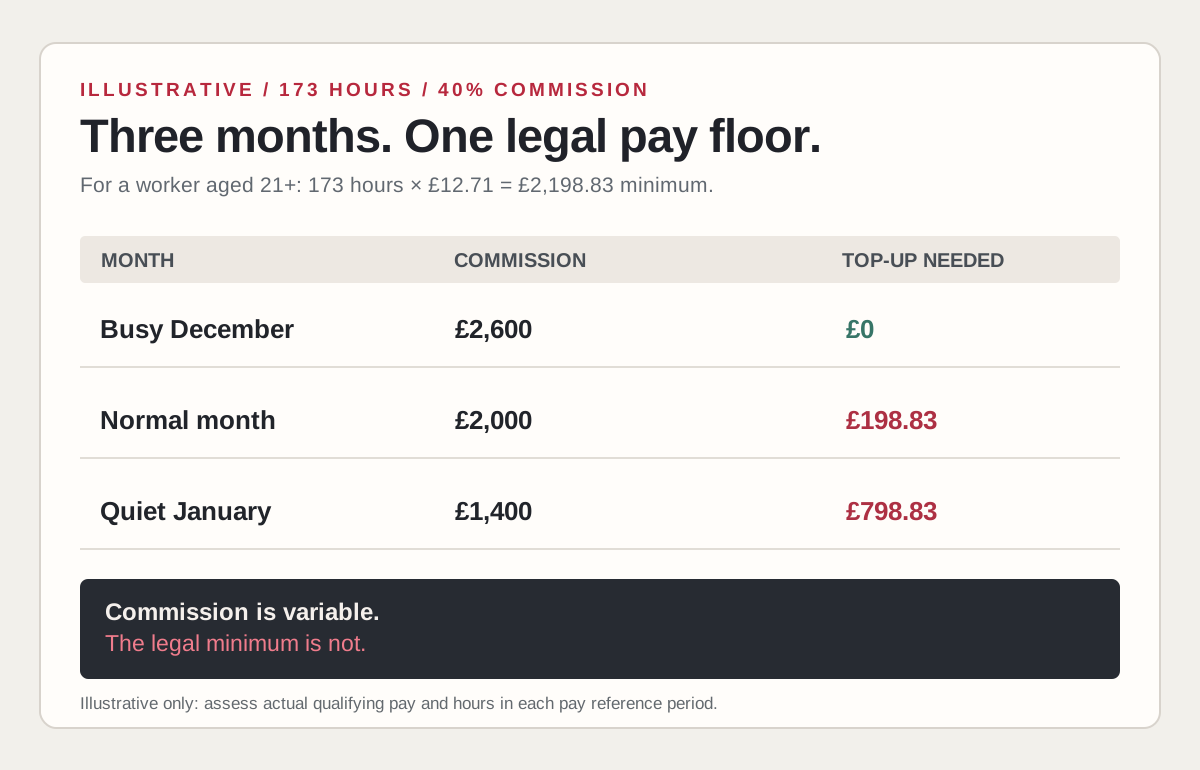
Take a barber aged 21 or over, on a 40% commission, and suppose the rota and time records show 173 hours in each month in which they had to be at work or available for work. Your real figure comes from your own records, and it changes from month to month: a month with 23 working weekdays at eight hours is 184 hours, not 173. On 173 hours, the minimum-wage floor for the month is 173 × £12.71 = £2,198.83. All figures are illustrative.
| Monthly takings from their chair | Commission at 40% | Effective hourly rate | Top-up needed to reach the minimum |
|---|---|---|---|
| £6,500 (busy December) | £2,600 | £15.03 | £0 |
| £5,000 (ordinary month) | £2,000 | £11.56 | £198.83 |
| £3,500 (quiet January) | £1,400 | £8.09 | £798.83 |
The arrangement that looked generous in December is unlawful in January unless the shop tops it up. On these hypothetical numbers, commission alone covers the minimum only when the chair takes about £5,497 a month (£2,198.83 ÷ 0.4). In a 184-hour month the floor is £2,338.64, so the chair would need about £5,847.
The same arithmetic shows something about the shop’s costs. Commission looks like a variable cost, but the minimum wage turns part of it into a fixed one. In practice, the shop is paying at least the floor for that rota (£2,198.83 on 173 hours), whatever the barber takes. Below the break-even takings, the barber’s pay doesn’t fall any further. Only the shop’s contribution does.
Three traps that reduce minimum-wage pay
1. Tips don’t count. GOV.UK lists tips, gratuities and service charges among the payments that don’t count towards minimum wage pay. A barber whose commission falls short can’t be “made up” by their tips. (Card tips also have to be passed on in full under separate rules.)
2. Deductions can push pay below the line. If you require barbers to wear a specific uniform and don’t supply it, GOV.UK says deductions for those items “will always reduce minimum wage pay”. The guidance treats other deductions and payments by workers in detail. Charging barbers for products, tools or “chair fees” while also employing them needs careful checking against it.
3. Premiums and most allowances don’t count. For time work, only the premium element of overtime or shift pay is excluded: the amount above the barber’s basic rate. The basic-rate part of those hours still counts. So paying a “Saturday premium” on top of the basic rate doesn’t help a barber who falls short on their basic pay. Most allowances and expense reimbursements are excluded too.
Structures that hold up

There’s no single correct structure. The law sets a floor, not a formula. Common approaches that work with the floor rather than against it:
- Base plus commission: a guaranteed hourly or monthly base at or above the minimum, plus a lower commission on takings above a threshold. The floor is met by design, and the barber still benefits from building a following.
- “Higher of” pay: each period, pay the higher of commission or the minimum for hours rostered. This is simple to explain, but it needs a monthly check, and the shop carries the risk in quiet months.
- Commission on a fair base: be clear whether commission is calculated on takings including or excluding VAT, and before or after product costs. A 40% commission on VAT-inclusive takings costs a VAT-registered shop more than it looks.
Whichever you choose, write it down. The barber’s written statement of terms should explain how pay is calculated, and you should be able to show for any month that the pay that counts, divided by the hours that count, was at least the rate.
The counterargument: “my barbers prefer pure commission”
Some experienced barbers prefer a straight percentage. They’re confident, busy and wary of a base that comes with a lower rate. Some owners worry that adding a base will discourage effort and inflate the wage bill.
That preference is real, and for a busy barber it matters less: in a normal month the commission is well above the floor. But the law doesn’t change because the employee agreed. A worker can’t sign away the minimum wage. The risk lies with the shop, not the barber, and it’s highest in exactly the months when cash is tightest. A “higher of” clause keeps the deal barbers like while making sure the shop never drops below the line. For the confident barber it costs nothing, because their commission is above the floor anyway. It only costs the shop in the months when the law would have required a top-up.
A monthly check
Once a pay reference period, for every employed barber:
- Qualifying hours: the hours they worked or were required to be at work and available, from the rota and time records for that period, not a standard figure.
- Qualifying pay: base plus commission and bonus that belong to this period, including commission earned now but paid in the next period. Leave out tips, the premium element of overtime or shift pay, and most allowances, and take off deductions that reduce minimum-wage pay, such as charges for required uniform you don’t supply.
- Divide qualifying pay by qualifying hours, and compare the result with the rate for their age and status.
- Top up any shortfall in that period’s pay, and keep the calculation with the payroll records.
It takes ten minutes with a spreadsheet. HMRC enforces the minimum wage, and finding a shortfall months later is far more expensive and awkward than ten minutes a month.
General information, not legal advice. Use GOV.UK’s minimum wage calculator or Acas for specific cases.
References
- GOV.UK, National Minimum Wage and National Living Wage rates (April 2026: £12.71 / £10.85 / £8.00 / £8.00; apprentice eligibility). gov.uk/national-minimum-wage-rates (accessed 16 Oct 2026).
- GOV.UK, Calculating the minimum wage: working hours for which the minimum wage must be paid (types of work; time work factors; time required to be available). gov.uk/guidance/calculating-the-minimum-wage (accessed 16 Oct 2026).
- GOV.UK, Calculating the minimum wage (pay reference period up to one month; commission timing; payments that don’t count, including tips, premia and allowances; uniform deductions). gov.uk/guidance/calculating-the-minimum-wage/calculating-the-minimum-wage (accessed 16 Oct 2026).
- Low Pay Commission, Consultation 2026 and Remit 2026 (rates for April 2027 not yet confirmed; central NLW projection £13.18). gov.uk/government/consultations/low-pay-commission-consultation-2026 (accessed 16 Oct 2026).