
How to Price a Haircut in the UK: A Floor, a Ceiling and the Price List In Between

Ask ten barbers how they set their prices and most will give a version of the same answer: “I looked at what the shop down the road charges.” It’s a sensible starting point. The trouble is it’s often the only one. The shop down the road may have different rent, different staff costs, and clients who come for different reasons. Copying its price copies its business model, including any mistakes in it.
A haircut price has to do three things. Across the price list, it has to cover what the time in the chair costs you on average. It has to be one that people in your area will pay. And it has to appear on the price list in a way the law accepts and clients understand. This article takes them in that order.
The floor: what an hour in the chair costs on average
The starting point is your own costs, not your competitors’. The useful figure is an average cost-recovery price: the price per booked hour that, if your bookings came in as planned, would cover the shop’s costs. This is a planning allocation, not the cost of any single appointment. With illustrative numbers:
- Monthly overheads (rent, rates, utilities, insurance, software, cleaning): £4,000.
- Planned booked hours across the shop in a month: two chairs × 120 booked hours = 240.
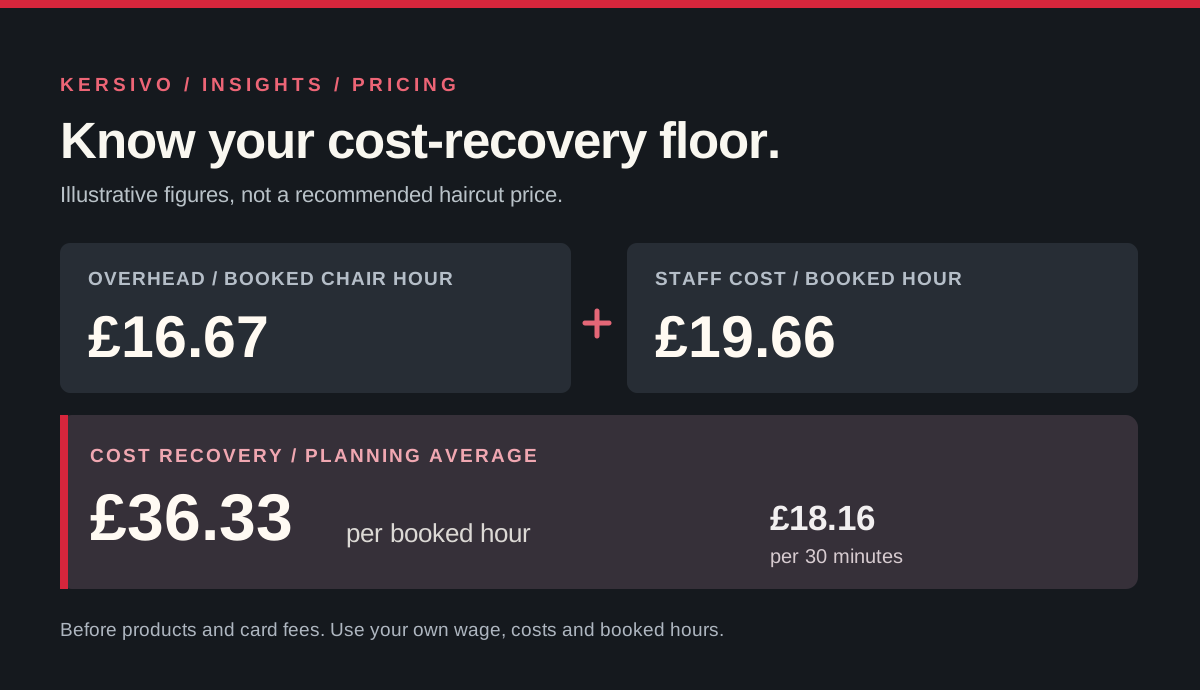
- Overhead allocated per booked hour: £4,000 ÷ 240 ≈ £16.67.
- Add an employed barber’s cost per booked hour. At the April 2026 National Living Wage of £12.71 for 37.5 paid hours a week all year, wages are about £24,785. Employer’s National Insurance at 15% above £5,000 adds about £2,968 (before any Employment Allowance), and a 3% pension contribution on earnings above £6,240 adds about £556. That’s about £28,309 a year. Spread over 1,440 booked hours (120 a month), that’s about £19.66 per booked hour. Holiday and quiet time are paid but not booked, so the cost per booked hour is well above the hourly wage.
- Together: about £36.33 per booked hour, or about £18.16 for a 30-minute cut, before products and card fees.
These figures are hypothetical. Use your own wage, hours, pension terms and booked hours.
What this number tells you is whether your price list, at the bookings you expect, covers the shop’s costs over the month. If your average price per booked hour sits below it, the shop as a whole won’t cover its costs at that level of bookings. That’s not the same as saying each cheap booking loses money. Three other numbers matter for individual decisions:
- Contribution per cut: price minus the costs that come with that cut, such as products, card fees and any commission.
- Incremental cost of one extra booking: if a salaried barber is sitting in an empty slot anyway, an extra £12 cut adds contribution, because the wage and rent are paid either way.
- Displacement when you’re full: when the diary is full, a cheap booking takes the place of one at your normal price, so it costs you the difference.
So the floor is a test of the whole price list, not a rule that every slot must earn £18.16. The divisor is booked hours, not opening hours, so a quiet Tuesday raises the average cost of every cut you do. And it’s per minute, so a skin fade that really takes 45 minutes needs a different price from a 20-minute clipper cut, even if both are called “a men’s cut”.
The ceiling: what your clients will pay

Above the floor, the market decides. This is where the shop down the road becomes useful, as long as you’re comparing like with like. Look at three or four nearby shops that a client would see as real alternatives: similar length of appointment, similar setting, similar standard of work. Note their prices for your three most common services. The spread tells you where the market is. It doesn’t tell you where you should sit in it.
Your position depends on what clients get from you that they don’t get elsewhere. That could be appointments that run to time, a barber with a following, a late evening slot, or the only shop in the area that does a particular style well. If you can’t say what that is, pricing at the top of the local range will be hard to sustain. If you can, pricing in the middle is probably leaving money on the table.
The test: before you raise prices
Most owners don’t struggle with the first price. They struggle with the second, the price rise. The fear is losing clients. A simple break-even calculation shows how many you could lose before the rise stops paying for itself.
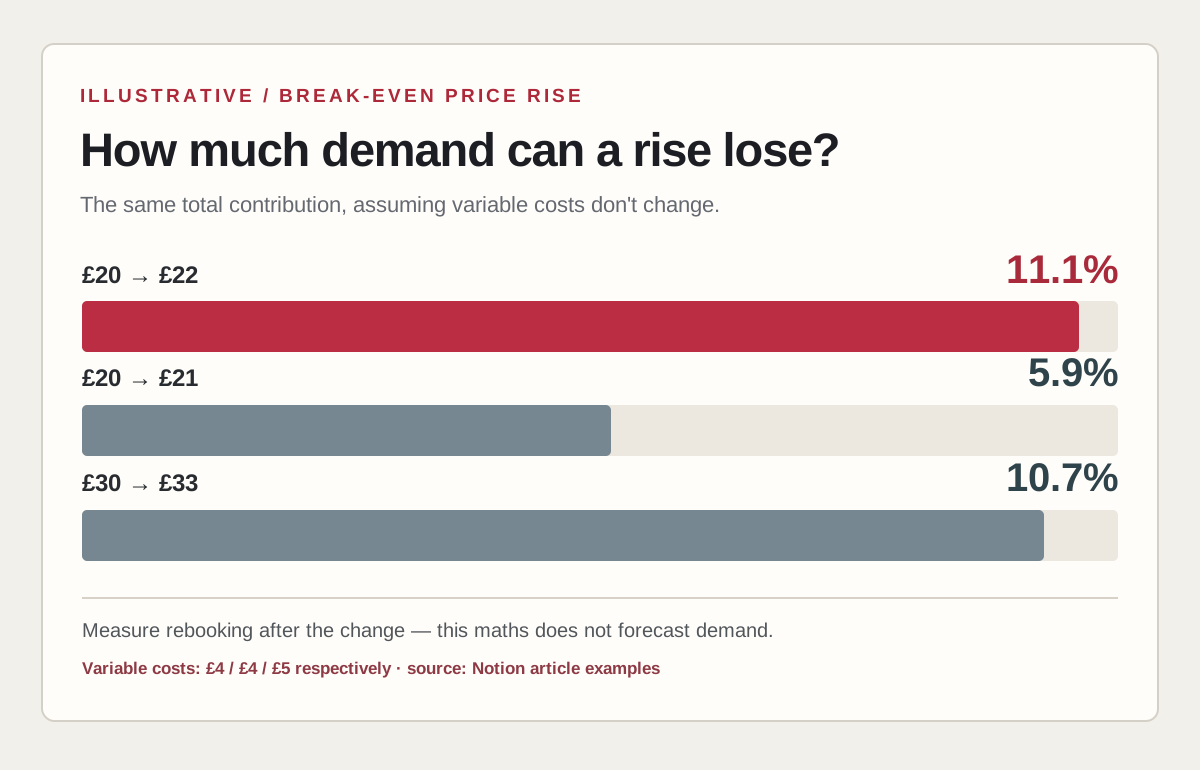
Illustrative example: a £20 cut where products and card fees cost about £4 leaves a contribution of £16. Raise the price to £22 and the contribution becomes £18. To earn the same total contribution, you need 16 ÷ 18 = 88.9% of your current cuts. In other words, you could lose about 11% of cuts and still have the same total contribution.
| Current price | Variable cost | New price | Cuts you can lose and break even |
|---|---|---|---|
| £20 | £4 | £22 | 11.1% |
| £20 | £4 | £21 | 5.9% |
| £30 | £5 | £33 | 10.7% |
(Calculated as 1 − old contribution ÷ new contribution, which is the same as the price rise ÷ the new contribution: £2 ÷ £18 = 11.1%; £1 ÷ £17 = 5.9%; £3 ÷ £28 = 10.7%.)
The test assumes the variable cost per cut stays the same and the barber’s pay doesn’t change with the number of cuts, which is true of a fixed wage. If you pay commission, include it in the variable cost. Freed-up chair time only adds anything if you can fill it with other clients; if you can’t, it’s just a quieter diary. And if the shop is full and turning people away, a rise may cost you very little, because lost bookings can be replaced. Whether a £2 rise announced in advance would actually cost you that many is an open question, so treat this as a test, not a promise. The real loss depends on your clients, and the way to learn it is to raise prices on one service first and watch your rebooking rate for six weeks.
One caution that matters for the bottom line: the extra £2 is extra contribution, not extra profit. If you pass some of it on as a pay rise or a rent-a-chair adjustment, the gain is smaller. The test still works. You just need to use the right number for “variable cost”.
The price list: the part the law has a view on
The price itself is up to you. How you show it isn’t entirely.
Show the price. Under regulation 8(1)(l) of the Provision of Services Regulations 2009, which apply across the UK, a service provider must make available “the price of the service, where a price is pre-determined by the provider for a given type of service”. One way to do this, set out in regulation 8(2), is to make it easily accessible where the service is provided. Regulation 11 says it must be clear, unambiguous and given in good time. A visible price list at the shop covers this. Online, the same principle is common sense.
Don’t drip. Since 6 April 2025, under the Digital Markets, Competition and Consumers Act 2024, the CMA says it’s illegal to hide fees or other charges the customer will have to pay until later in the purchase (“drip pricing”). The CMA can fine businesses up to 10% of turnover or £300,000, whichever is greater. The CMA’s price-transparency guidance (CMA209) names booking fees as an example of a mandatory charge and says an indicative or “from” price is allowed as long as it includes all mandatory charges and doesn’t mislead customers about what the price covers. If every online booking carries a fee the client must pay, it belongs in the price they see first.
Make “from” honest. “Skin fade from £20” is likely to be fine if a reasonable number of clients actually pay £20. If almost everyone ends up paying £26 because of the “extras”, the headline is doing the misleading for you. A clearer approach is to price by service and length: “Skin fade (45 min) £26; scissor cut (30 min) £22; beard trim (15 min) £10”.
The counterargument: “my clients won’t pay more”
Some owners, especially in lower-income areas, will say this is all theory. Local clients have a fixed idea of what a haircut costs, and a shop that goes above it simply empties.
That’s a real risk, and it’s why the method begins with the floor rather than the ceiling. If the floor (your cost per booked minute) is above what your area will pay, the problem isn’t your price list. It’s the cost base or the diary. The answer may be fewer empty hours rather than a higher price, which is a different conversation. What the method warns against is pricing the whole list below the average cost of a booked hour because the market seems to demand it, and hoping volume will cover the gap. Volume only helps if there are empty slots to fill and each extra cut adds contribution.
There’s also the opposite objection: that a premium price is itself a signal, and clients read a cheap cut as a poor cut. That can be true. It’s also the easiest pricing story to tell yourself without evidence. A small test on one service, with the rebooking rate as the measure, will tell you more than either belief.
A one-page method
- Work out your average cost per booked hour, then per minute, as a planning check.
- Check each service’s price against it, using the service’s real length, and know its contribution per cut.
- Compare three or four genuine local alternatives to find the range.
- Decide where you sit, based on something clients can actually see.
- Before any rise, run the break-even test with your real variable costs and try it on one service first.
- Show prices clearly. Include any mandatory booking fee. Keep “from” prices honest.
A price is the most important number in a barbershop, and in most shops it’s set by copying the shop down the road. Setting it from your own costs takes about an hour with a spreadsheet.
References
- The Provision of Services Regulations 2009 (SI 2009/2999), regulations 8 and 11 (UK). legislation.gov.uk/uksi/2009/2999/regulation/8 (accessed 16 Oct 2026).
- Competition and Markets Authority, Unfair commercial practices (CMA207) (DMCC Act provisions from 6 April 2025; drip pricing). gov.uk (accessed 16 Oct 2026).
- Competition and Markets Authority, Providing clear and accurate information about prices (CMA209 summary). gov.uk/government/publications/price-transparency-cma209 (accessed 16 Oct 2026).
- GOV.UK, National Minimum Wage and National Living Wage rates (£12.71 from 1 April 2026). gov.uk/national-minimum-wage-rates (accessed 16 Oct 2026).
- CMA, Providing clear and accurate information about prices (summary): “from” prices and mandatory charges. gov.uk/government/publications/price-transparency-cma209/providing-clear-and-accurate-information-about-prices-summary (accessed 16 Oct 2026).