
The 20p You Don’t Notice: How Card Fees Really Work for a Barbershop
For many barbershops, card is now the normal way clients pay, and most owners can quote their card rate from memory. It’s usually a percentage. That number is only half the story, and for a business selling £12 to £40 services, often the less important half.
Many card providers charge a percentage plus a fixed fee on every payment. Stripe’s published UK pricing for online card payments, for example, is 1.5% plus 20p for standard UK cards and 2.8% plus 20p for premium UK cards. Its in-person pricing, for payments taken on its card readers, is different: 1.4% plus 10p for EEA cards and 2.9% plus 10p for non-EEA cards. (Stripe’s page doesn’t spell out which band UK-issued cards fall into in person, so check your own statement or ask.) The fixed part doesn’t care how much the haircut cost. On a cheap service it can be the biggest part of the fee.
Same rate, different cost
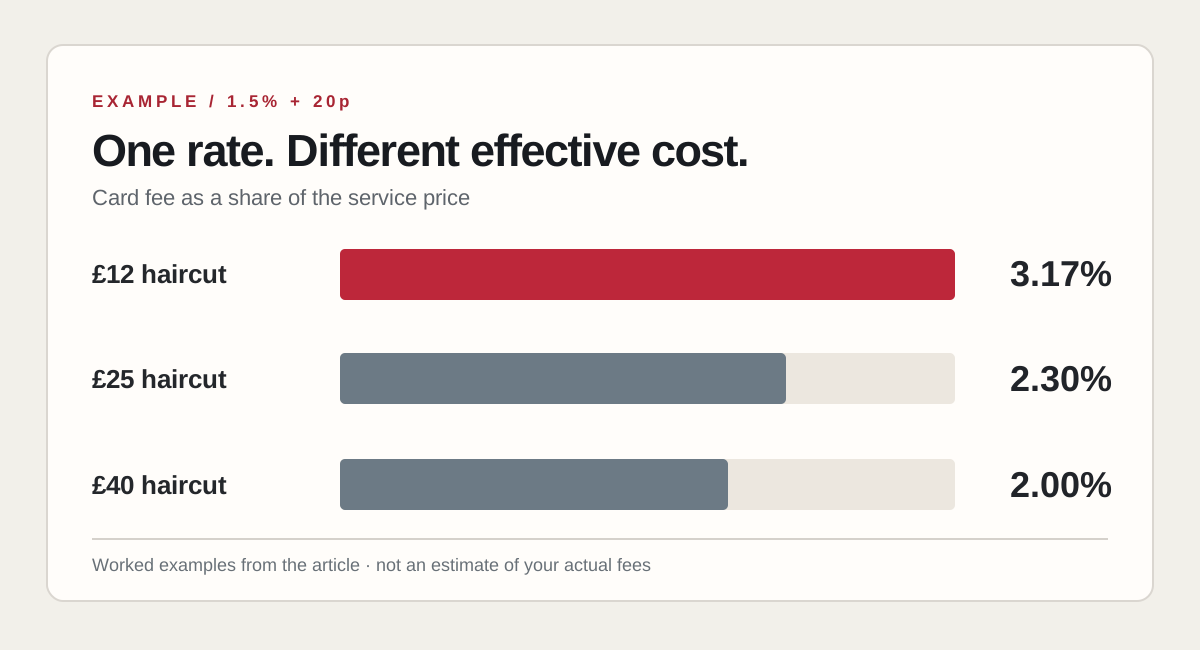
Take the online rate of 1.5% plus 20p and apply it to three prices. These are worked examples using a published rate, not a claim about what you pay.
| Card payment | Fee at 1.5% + 20p | As a share of the price | Fee at 2.8% + 20p (premium card) | As a share |
|---|---|---|---|---|
| £12 | £0.38 | 3.17% | £0.54 | 4.47% |
| £25 | £0.58 | 2.30% | £0.90 | 3.60% |
| £40 | £0.80 | 2.00% | £1.32 | 3.30% |
The headline rate is 1.5%, but a £12 kids’ cut costs more than twice that. The same rate on a £40 service costs 2%. The cheaper the service, the more the fixed fee weighs.
That has a practical consequence. Anything that splits one visit into several card payments adds another fixed fee each time. How many fees a visit carries depends on how each part is paid:
- An online deposit, then the balance in cash: one card payment, so one fixed fee. On a £5 deposit at 1.5% plus 20p, that’s about 28p.
- An online deposit, then the balance by card in the shop: two card payments, two fixed fees, and possibly two price lists. Using Stripe’s published rates as an example, a £5 online deposit and a £20 balance on a card reader at 1.4% plus 10p cost about 66p in total. That compares with about 58p for £25 paid online in one go, or 45p for £25 on the reader.
- A cut, then a separate payment for a pot of wax: two payments, two fixed fees.
Your own provider may price these differently. None of this is a reason to stop taking deposits, but it is a cost worth knowing.
Your real rate is a blend
The rate on your contract is not the rate you pay. Your real rate depends on the mix of cards your clients use and the size of the payments.
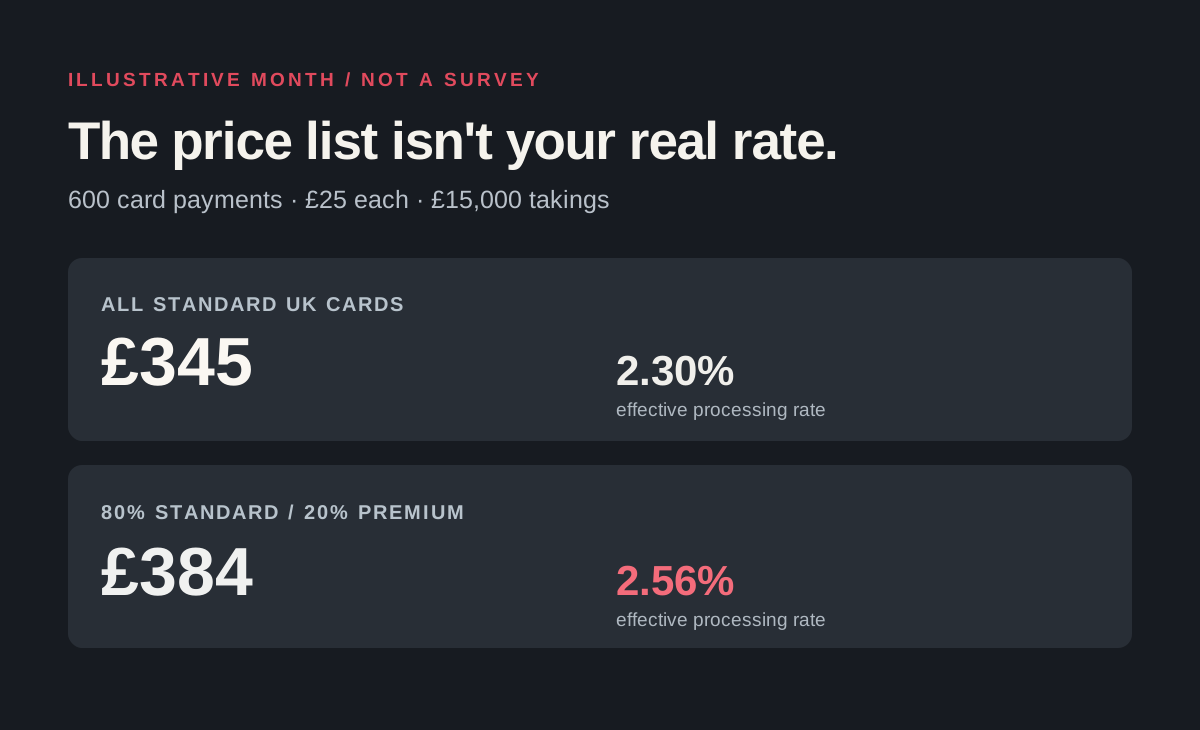
Here is a hypothetical month, counting processing fees only: 600 card payments, all for £25, so £15,000 taken by card. If every client paid with a standard UK card at 1.5% plus 20p, fees would be £345. Now suppose a fifth of them used premium cards at 2.8% plus 20p. Fees rise to £384: £276 on the standard cards and £108 on the premium ones. That’s an effective rate of 2.56% on a contract that says 1.5%. This figure covers only the fees on each payment. It leaves out dispute fees, card reader costs, and any monthly or per-authorisation charges, which you’d add to get the full cost of taking cards.
The way to find your own figure is simple, and most owners never do it. Take a month’s statement from your provider, add up every fee, and divide by the total card takings. That single percentage is the number to compare when a salesperson offers you a “lower rate”.
It also makes comparisons honest. Imagine a hypothetical provider, not a real offer, charging a flat 1.75% with no fixed fee. It would cost £262.50 on the month above. That’s cheaper than either version of the fixed-fee model at £25 a payment. If every client used a standard card at 1.5% plus 20p, the comparison would flip only once the average payment rose above £80, because that’s where the 20p is outweighed by the extra quarter of a percent. With a fifth of clients on premium cards, as in our example, the flat rate stays cheaper at every price. Fees on a statement beat rates on a brochure.
One more thing to check while you have the statement open. Many providers price online payments and in-person payments differently, and some charge extra for card types or currencies you rarely think about, such as cards issued abroad. If you take deposits online and the rest at the counter, you may be on two different price lists at once. Your blended rate should include both, because that’s what leaves your account. A shop near a station or a hotel, with more visitors from abroad, can see a noticeably different blend from a shop on a residential high street, even at the same prices.
Can you pass the cost on?
No, not as a card surcharge. Since 13 January 2018, regulation 6A of the Consumer Rights (Payment Surcharges) Regulations 2012, inserted by the Payment Services Regulations 2017, says a payee “must not charge a payer any fee” for payment by a card-based payment instrument that isn’t a commercial card. That covers the ordinary debit, credit and prepaid cards your clients use. The same ban applies to many other electronic payment methods. Business-to-business commercial cards can still be surcharged, but never by more than the cost to you. For a barbershop serving the public, a “card fee” sign at the till is not an option.
What you can do is set prices that cover your real costs, including card fees. That turns the question from “how do I charge for cards?” into “what does a card payment actually cost me per service?”, which is the question the table answers.
Cash isn’t free either. It has its own costs: time spent counting and banking, bank charges for deposits, and the risk of loss. Some shops find card cheaper overall once those are counted. Without your own figures, nobody can tell you which is cheaper for you.
The fee nobody budgets for
Disputes are rare, but they’re expensive. Stripe’s published UK pricing lists a £20 fee for each dispute received, and another £20 if you respond to it manually, which you get back only if you win. If you lose, you usually lose the payment too. On the standard rate, that’s the same as the fees on about 35 card payments of £25. One disputed booking can wipe out a week’s saving from a slightly better rate.
The best protection is unglamorous: a clear name on the client’s bank statement so they recognise the payment, a booking record they agreed to, and a quick reply when a client queries a charge with you before going to their bank.
How it plays out by shop
For an owner-operator or a shop with employed barbers, card fees come out of the shop’s takings. They are a true variable cost: they rise and fall with every payment.
For chair renters, it depends on who takes the payment. If each renter has their own card reader and account, the fees are theirs. If the shop takes all payments and pays renters their share, the agreement should say who carries the card fees. Otherwise the shop may be quietly absorbing a cost that belongs to someone else, or the other way round.
What to do with this
There are three things worth doing this month. Work out your real card rate from a full month’s statement. Look at your cheapest services and check whether the fixed fee is a large share of the price. And count how many visits are split into more than one card payment.
None of it needs a new provider. It needs one afternoon with a statement and a calculator. If the numbers then say your prices or your provider no longer fit, you’ll be making that change on evidence rather than on a headline rate.
References (checked 16 October 2026; rechecked and item 3 added in v2)
- The Consumer Rights (Payment Surcharges) Regulations 2012, reg. 6A (in force from 13 January 2018) — https://www.legislation.gov.uk/uksi/2012/3110/regulation/6A
- Stripe, UK pricing (online: standard UK cards 1.5% + 20p, premium UK cards 2.8% + 20p; Terminal in-person: 1.4% + 10p EEA cards, 2.9% + 10p non-EEA cards; dispute received £20, dispute countered £20) — https://stripe.com/gb/pricing
- The Payment Services Regulations 2017, Sch. 8 para. 12 (inserting regs 6A–6B) — https://www.legislation.gov.uk/uksi/2017/752/schedule/8