
Barbershop Gift Vouchers: Cash in December, a Haircut You Owe in March
Every December, the same thing happens at the counter. Someone’s partner, mother or best mate wants to buy a haircut as a present, and the shop either has something to sell them or doesn’t. Gift vouchers look like easy money: paid in full and up front, at a time of year when plenty of people walk past the window.
They’re worth selling. But a voucher isn’t income in the way a haircut is. It’s a promise to cut someone’s hair later, paid for now, and that promise has rules: on expiry, on VAT, and in your books. The owners who do well from vouchers are the ones who know which part is cash, which part is revenue, and which part is a debt.
What you’ve actually sold
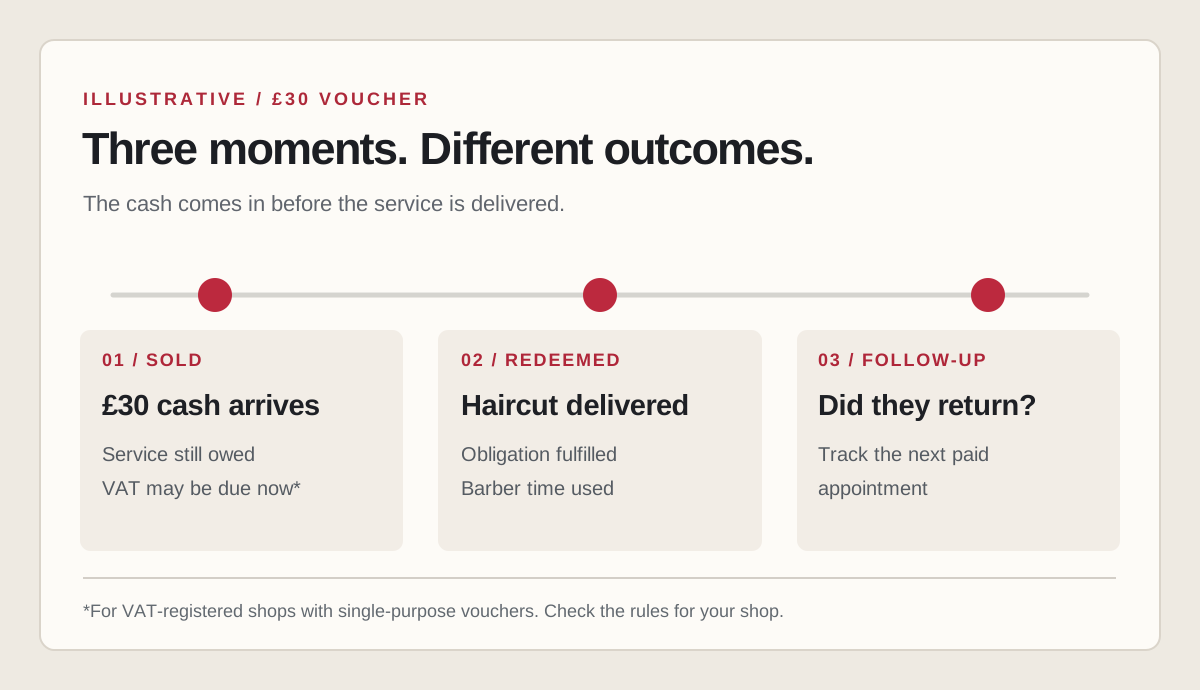
When a client pays £30 for a voucher, the shop has the £30. It hasn’t earned it yet. Until the voucher is used, you owe £30 of services at your prices to whoever turns up holding it. Five different things are happening, and it helps to keep them apart:
- Cash: £30 in the bank now.
- VAT, if you’re registered: usually due now, on the sale (see below).
- An obligation: a cut, or £30 of services, you still have to deliver.
- Accounting revenue: usually recognised later, when you deliver the cut. Until then the voucher normally sits in your accounts as a liability (under the new FRS 102 wording, a “contract liability”).
- Profit: what’s left after the cost of delivering the cut, which also comes later.
For accounts under FRS 102, the revenue section was rewritten for periods beginning on or after 1 January 2026. It now follows a five-step model close to the international standard, IFRS 15, and it includes guidance on vouchers that are never used. Many very small shops prepare accounts under other rules (FRS 105, or cash-basis tax figures for sole traders), and the right treatment depends on which applies to you and on your voucher terms. Ask your accountant how they want it shown, because it changes how a December looks in your accounts.
This matters for three reasons:
- Cash isn’t profit. £1,200 of December voucher sales (illustratively, 40 vouchers at £30) is £1,200 in the bank, but it’s matched by £1,200 of services at your prices that you’ll have to deliver later. If a cut costs £30, that’s 40 cuts of barber time. If a cut costs £24, the same vouchers buy 50 cuts, and some will be part-used or topped up. If you’re VAT-registered, £200 of the £1,200 is VAT, so the most it can become in revenue is £1,000.
- Timing shifts the strain. If those 40 vouchers are all redeemed on Saturdays in January, they take paying slots. If they fill quiet Tuesday mornings that would genuinely have been empty, the main cost is products and card fees.
- Who redeems them decides their value. A voucher used by an existing regular, who’d have come and paid anyway, is mostly a change in the timing of cash. A voucher used by someone new is a first visit, not yet a regular. It turns into a client acquisition only if they come back and pay, which is where most of the commercial value of vouchers lies.
The expiry question
Owners often ask how long a voucher has to last. There’s no fixed answer in law. In a written parliamentary answer in July 2023, the Department for Business and Trade said: “there is no legal minimum term for the validity of gift cards”. The government has encouraged businesses, working with the UK Gift Card & Voucher Association, to use expiry dates of at least two years, and to be transparent about terms. That two-year figure is guidance, not law. In June 2026 a minister again answered that the Law Commission had found no need for additional measures, including on expiry dates, so as of October 2026 there’s no proposal before Parliament for a legal minimum.
“No legal minimum” isn’t the same as “anything goes”. The Consumer Rights Act 2015, Part 2, says unfair terms in consumer contracts aren’t binding on the consumer, and written terms have to be transparent. A very short expiry date hidden in small print is the kind of term that invites a challenge. It’s also the kind that goes down badly on a review page. The practical approach is simple. Print the expiry date clearly on the voucher itself. Make it generous enough that nobody feels caught out; the two-year guide is a sensible reference. And say whether the voucher can be part-used, topped up, or transferred.
VAT: due when you sell, not when you cut
This section only applies if your shop is VAT-registered. If it is, vouchers follow specific rules under Schedule 10B to the Value Added Tax Act 1994, in force since 1 January 2019.
Section 9 of HMRC’s VAT Notice 700/7 sets out two kinds. A voucher is a single-purpose voucher if, when it’s issued, the place of supply and the VAT due on what it can be spent on are both known. A barbershop voucher that can only be used in your UK shop for haircuts and products, all standard-rated, is likely to be single-purpose. If it could be spent on things with different VAT treatment, or with another business, it may be a multi-purpose voucher, and the VAT treatment is different. For these vouchers, HMRC’s guidance in VAT Notice 700/7 says VAT is accounted for when the voucher is sold, not when it’s redeemed. No further VAT is due on redemption. And no adjustment can be made if the voucher is never used, unless you give a refund.
In the illustrative example, 40 vouchers at £30 means £200 of VAT due in the VAT period when they’re sold (one-sixth of £1,200), even though the haircuts haven’t happened yet. For a multi-purpose voucher, VAT is generally accounted for when it’s redeemed, not when it’s sold. If you sell anything unusual, such as a voucher that can be spent at a partner business, check with your accountant.
A discounted voucher, say “£50 of haircuts for £40”, is taxed on what the customer actually paid, not on the face value. The £10 discount is a real cost, though. You give up £10 of revenue you’d otherwise have earned from the £50 of services.
When vouchers make money, and when they don’t
Here’s an honest way to judge your voucher sales. Take the vouchers redeemed in a year and sort them into two groups:
| Redeemed by | What the voucher really did | Commercial value |
|---|---|---|
| An existing regular | Moved cash earlier; may have replaced a paid visit | Low: mainly timing |
| Someone new who then rebooked | Brought in a client who stays | High: new client at little cost |
| Someone new who never came back | One cut delivered for money already received; one first visit, not a retained client | Neutral to low |
You won’t know which group a voucher falls into when you sell it. You can find out when it’s redeemed, by noting the voucher on the booking and checking afterwards whether the person comes back. A shop where most vouchers go to regulars has a cash-flow tool. A shop where many go to new clients, and some of those stay, has a cheap marketing channel. Both are useful, but the second is worth much more effort.
Two practical points improve the odds. First, design the voucher for the person receiving it, not the buyer: include the booking link or phone number, and say how to book. Second, consider making vouchers redeemable at quieter times, or at least encourage it. A voucher redeemed in a slot that would otherwise have stayed empty displaces no paid work. If Tuesday mornings are already booked, steering vouchers there doesn’t save anything.

The counterargument: unredeemed vouchers are free money
Some owners quietly count on vouchers that never get used. Every voucher that expires unused is cash with no haircut to deliver. On that view, a short expiry and a forgetful public make vouchers very profitable.
It’s true that some vouchers go unredeemed. How and when that becomes income in your accounts depends on your accounting framework and your voucher terms. Under FRS 102 from 2026 and IFRS 15, a business that can reliably estimate how many vouchers won’t be used may recognise that “breakage” gradually as other vouchers are redeemed; otherwise it waits until use becomes unlikely, such as at expiry. Your accountant will decide which applies. But building a strategy on it is a poor bet for a local business. A voucher bought as a present is often bought by a regular. If their partner turns up a week after an expiry date nobody noticed, the shop loses more than the £30 of goodwill it saved. The government’s two-year guide and the transparency requirement point the same way. Treat unredeemed vouchers as a small bonus, not as the business case.
Before you sell the first one
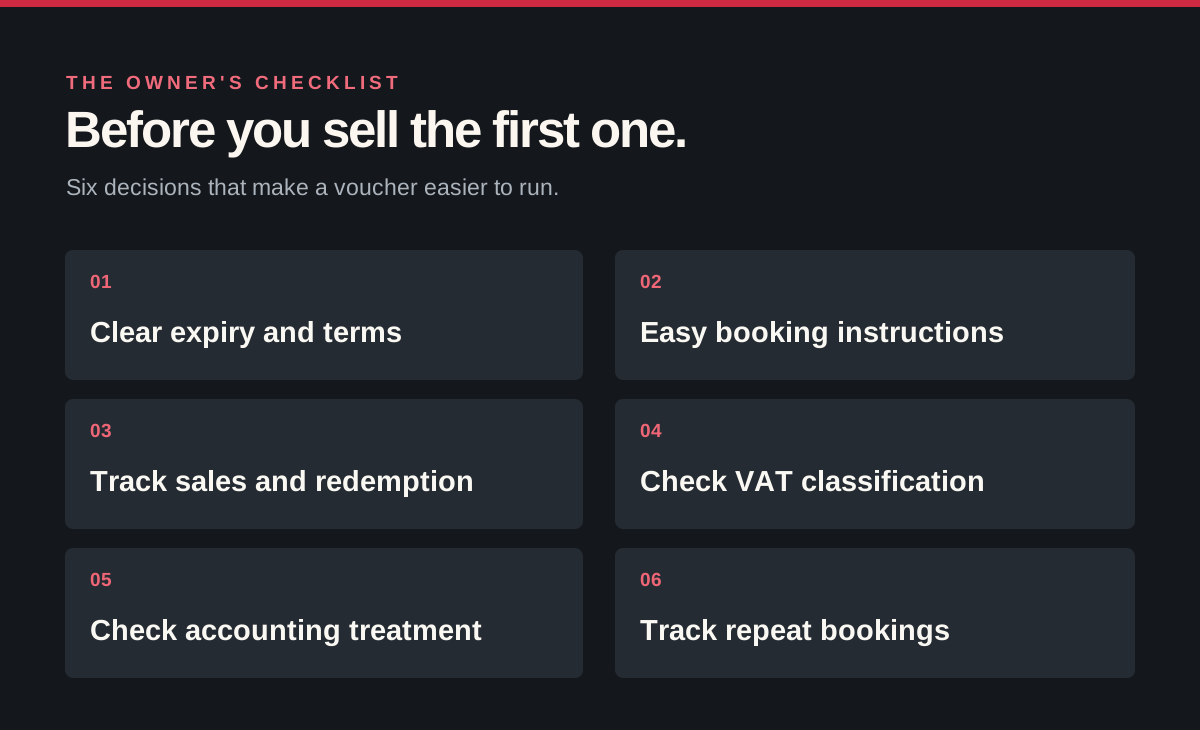
- Print the expiry date (two years is a sensible guide) and the terms clearly on the voucher.
- Put the booking link and instructions on it.
- Keep a simple register: number, value, date sold, date redeemed.
- If you’re VAT-registered, check whether your vouchers are single-purpose (VAT on sale) or multi-purpose (VAT on redemption).
- Ask your accountant how to show unredeemed vouchers in your books.
- Note who redeems, and check whether new clients come back.
A voucher sold in December is a client you might gain in February. The paperwork is small, and the useful part is that note at redemption telling you whether the voucher brought someone new.
General information, not legal or tax advice.
References
- Hansard, written answer by Kevin Hollinrake (Department for Business and Trade), 21 July 2023, Voucher Schemes (“no legal minimum term for the validity of gift cards”; at least two years encouraged with the GCVA; Law Commission view). theyworkforyou.com/wrans/?id=2023-07-13.194072.h (accessed 16 Oct 2026).
- Consumer Rights Act 2015, Part 2 (unfair terms; transparency). legislation.gov.uk/ukpga/2015/15/part/2 (accessed 16 Oct 2026).
- Value Added Tax Act 1994, Schedule 10B (vouchers; single-purpose voucher definition, para 4). legislation.gov.uk/ukpga/1994/23/schedule/10B (accessed 16 Oct 2026).
- HMRC, Business promotions (VAT Notice 700/7), section 9.4 (single-purpose vouchers: VAT on issue; none on redemption; no adjustment if unused unless refunded). gov.uk/guidance/business-promotions-and-vat-notice-7007 (accessed 16 Oct 2026).
- HMRC, VAT: treatment of vouchers from 1 January 2019. gov.uk (accessed 16 Oct 2026).
- Financial Reporting Council, Amendments to FRS 102 – Periodic Review 2024 (new Section 23 revenue model, periods beginning on or after 1 January 2026); ICAEW, FRS 102 amendments – revenue recognition. icaew.com (accessed 16 Oct 2026).
- UK Parliament written answer by Kate Dearden (DBT), 4 June 2026, Retail Trade: Voucher Schemes (Law Commission: no additional measures, including on expiry). questions-statements.parliament.uk (accessed 16 Oct 2026).