
The Extra Hour Test: Planning a Barbershop’s December Without Fooling Yourself

Every barbershop owner knows what December looks like. Everyone wants a cut in the same three weeks, the diary fills by the end of November, and the phone keeps ringing anyway. The usual response is to open longer: earlier mornings, late evenings, an extra Sunday. Sometimes it’s the best decision of the year. Sometimes it’s two weeks of exhaustion that, once you work out the numbers, made very little money.
The difference between the two isn’t how busy the shop is. It’s whether each extra hour pays for what it adds. This article sets out a simple test for that, and the planning around it.
The calendar first
The fixed points for 2026–27, from GOV.UK’s bank holiday list (checked 16 October 2026):
| Date | England & Wales | Scotland | Northern Ireland |
|---|---|---|---|
| Fri 25 Dec 2026 | Christmas Day | Christmas Day | Christmas Day |
| Mon 28 Dec 2026 | Boxing Day (substitute day) | Boxing Day (substitute day) | Boxing Day (substitute day) |
| Fri 1 Jan 2027 | New Year’s Day | New Year’s Day | New Year’s Day |
| Mon 4 Jan 2027 | — | 2nd January (substitute day) | — |
Boxing Day falls on a Saturday in 2026, so the bank holiday moves to Monday 28 December. Many shops will want to open on Saturday 26th anyway. For staff, GOV.UK is clear that “bank or public holidays do not have to be given as paid leave”. Whether your barbers get them off, or get extra pay for working them, depends on their contracts. Check those before you build the rota, not after.
The extra hour test
When you consider an extra hour, say 7pm to 8pm on the Thursdays before Christmas, only three things matter: what it adds in revenue, what it adds in cost, and what it takes away from other hours.
Leave out everything that doesn’t change. Your rent, business rates, software subscription and insurance are the same whether you close at 7 or 8. Spreading them across the extra hour (“each hour costs us £17 in overheads”) makes the hour look worse than it is. That’s the overhead allocation trap: those costs belong in the question of whether the business is viable, not in this one.
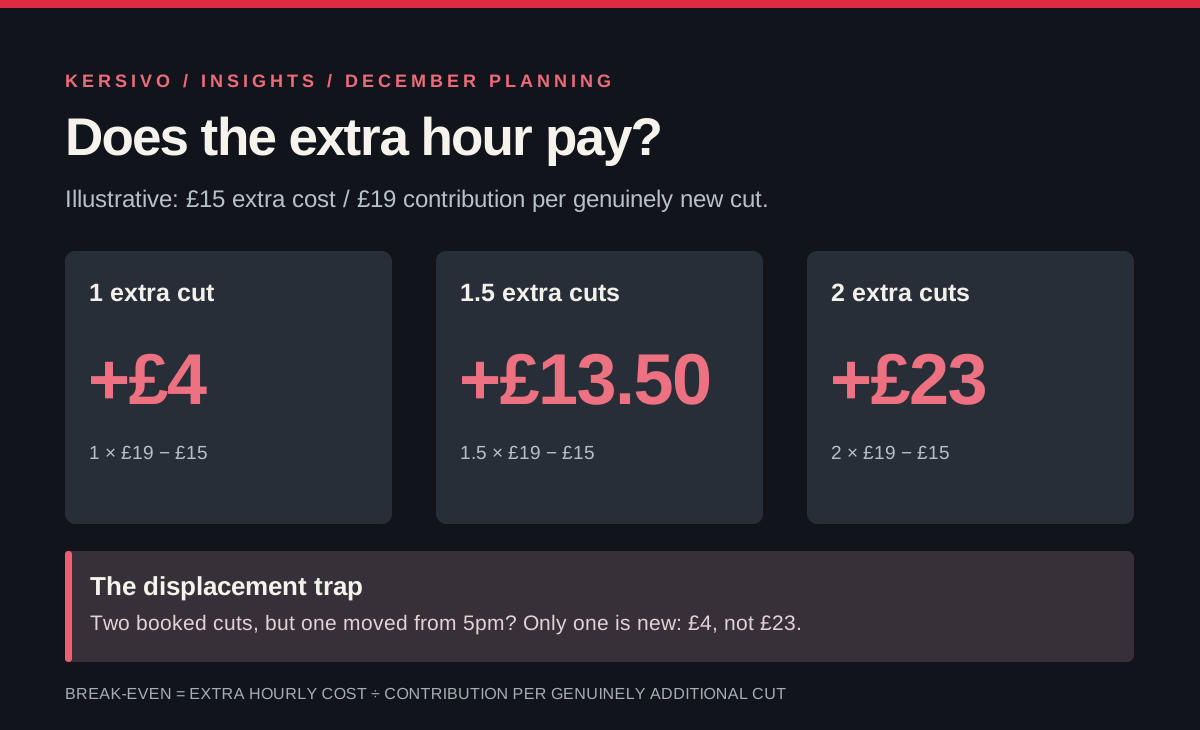
Here’s an illustrative case. An employed barber works an extra hour that costs the shop about £15. That assumes the barber is 21 or over on the April 2026 National Living Wage of £12.71, plus 15% employer’s National Insurance (assuming their earnings are already above the £5,000 threshold) and a 3% pension contribution: £12.71 × 1.18 ≈ £15.00. A higher hourly rate or an overtime premium raises it, and regular overtime can also add to holiday pay. A cut costs £22, and the variable costs per cut (products and card fees) come to about £3. So each cut adds £19 of contribution.
- Two cuts in the hour: 2 × £19 − £15 = £23 extra contribution.
- One and a half cuts on average: 1.5 × £19 − £15 = £13.50.
- The hour breaks even at about 0.8 cuts: £15 ÷ £19 ≈ 0.79.
In general: break-even cuts = extra cost of opening the hour ÷ contribution per genuinely additional cut. The extra cost includes the barber’s pay and any other cost that only arises because you open, such as heating and lighting for the extra hour.
That’s a low bar, so a December hour that actually gets booked will usually pass. The test only works if the hour is filled with extra demand, though. That’s the third element.
The displacement question
Suppose your regulars would have come in at 5pm anyway, and now they come at 7.30pm because the slot is there. The 7.30pm cut isn’t new revenue. It’s the same cut, moved. You’ve paid for an extra hour of wages to deliver a haircut you’d already have had.
So the honest version of the test is about net new cuts. If two cuts are booked in the hour but one would have happened at 5pm anyway, only one is new: 1 × £19 − £15 = £4. The hour still just pays, but by much less than the £23 it seemed to make. In a genuinely busy December, displacement is likely to be at its lowest: the diary is genuinely full and the extra hours catch demand that would otherwise go elsewhere. But if your daytime slots in early December aren’t full, adding evening hours mostly moves people around. You can see this from your own diary. Compare last year’s bookings by hour for the first and third weeks of December.
The wage that doesn’t change
There’s an important exception to the arithmetic above. If the barber is on a fixed salary and the extra hour is within their contracted hours, for example moving a quiet Tuesday-morning hour to a Thursday evening, the wage isn’t an extra cost at all. Whether you can move hours like that depends on the contract. Many contracts fix days or hours, so changing them may need the barber’s agreement. It’s paid either way. In that case, the extra hour costs only the variable costs of the cuts and a small amount of energy. But the hour you moved it from is now closed, so count any bookings you lose there as displaced.
The reverse is also true. If you agree a December bonus or overtime rate, it’s a real extra cost, and it should go into the test. Mixing these up is how owners either turn down hours that were nearly free or accept hours that weren’t.
Making December pay into January

The bigger commercial opportunity of December is often in January. If your weeks after New Year are quiet, part of the reason is obvious: plenty of clients had a cut just before Christmas. The clients you see in mid-December are the best people to book into late January, because their next cut will fall due then.
Three practical habits:
- Rebook at the chair. Before the December client leaves, offer a slot five or six weeks ahead. This is the cheapest January marketing you can do.
- Contact lapsed clients early. If you plan to text or email past clients about December availability, do it in November. Without their consent, the ICO’s “soft opt-in” only lets you do this if all of these are true: you got their details during a sale or the negotiation of a sale, such as a booking; you’re marketing your own similar services; you gave them a simple chance to opt out when you collected their details; and you give them the chance to opt out in every message. The ICO has said this guidance is being reviewed after the Data (Use and Access) Act 2025, so check the current version before sending.
- Protect the team. Long December days are worth less if a barber is off sick in the first week of January. Some owners close an extra day after the peak on purpose. On the test above, that’s often cheap, because those January hours would have been half-empty anyway.
The counterargument: “just open every hour you can”
There’s a simple school of thought that December is the harvest and you should be open whenever someone might walk in. Empty chairs in December are a failure.
There’s something in it: demand is unusually concentrated, and turning people away has a cost. But “open every hour” ignores two things the test catches. One is displacement: some of those hours just move regulars around. The other is the cost of an empty hour, which is small for one evening but not over twenty of them at overtime rates. The better rule is to open the hours your diary shows are needed, which isn’t the same as opening the most hours.
A December planning sheet
| Step | What to check |
|---|---|
| Calendar | Bank holidays (25 and 28 Dec; 1 Jan; 4 Jan in Scotland); which days you’ll open |
| Contracts | Who is entitled to what on bank holidays; overtime or bonus rates; whether hours can be moved without agreement |
| Last year | Bookings by hour, weeks 1 vs 3 of December; turn-aways |
| Extra hours | Extra cost of the hour ÷ contribution per genuinely additional cut = break-even cuts |
| Displacement | Will the hour bring new cuts, or move existing ones? |
| January | Rebook at the chair; contact lapsed clients in November within the soft opt-in rules |
| Team | Plan rest after the peak |
December isn’t a test of who works the longest hours. Each hour can be judged on whether it pays, and planned accordingly.
References
- GOV.UK, UK bank holidays (2026–27 dates by nation). gov.uk/bank-holidays (accessed 16 Oct 2026).
- GOV.UK, Holiday entitlement: bank holidays (“Bank or public holidays do not have to be given as paid leave”). gov.uk/holiday-entitlement-rights/bank-holidays (accessed 16 Oct 2026).
- Information Commissioner’s Office, Electronic mail marketing (soft opt-in; guidance under review following the Data (Use and Access) Act). ico.org.uk (accessed 16 Oct 2026).
- GOV.UK, National Minimum Wage and National Living Wage rates (£12.71 from 1 April 2026). gov.uk/national-minimum-wage-rates (accessed 16 Oct 2026).