
Google Reviews for Barbershops: Two Rulebooks, One Habit

Two barbershops sit on the same high street. One has 41 Google reviews averaging 4.9, the other has 380 averaging 4.6. Someone new to the area searches “barber near me”, and Google has to choose which one to show first. Most owners assume the 4.9 wins. It may not, but reviews are only part of the answer. Google says local results are mainly based on relevance (how well a profile matches the search), distance (how far the business is from the searcher) and prominence (how well known it is), and that review count and ratings feed into prominence. So the nearer shop with the better-matched profile can come first whatever its review count. Still, a long, steady record of reviews tells both Google and a stranger that people keep coming to this place.
So the useful question for an owner isn’t “how do I get five-star reviews?” It’s “how do I get a steady flow of honest reviews, without breaking either of the two rulebooks that now cover them?”
Rulebook one: the law
Since 6 April 2025, the Digital Markets, Competition and Consumers Act 2024 (Schedule 20, paragraph 13) has made certain review practices automatically unfair across the UK. Nobody has to show that a customer was actually misled. The banned practices are:
- submitting a fake review, or getting someone else to write or submit one. “Fake” means it claims to be based on a genuine experience when it isn’t.
- submitting or commissioning a review that hides the fact it was incentivised. The Act’s definition of “commissioning” includes incentivising “by any means”.
- publishing reviews, or information drawn from them, in a misleading way. The Act’s examples include removing negative reviews while keeping positive ones, and giving positive reviews more prominence.
The Competition and Markets Authority published its guidance (CMA208) on 4 April 2025. Under the same Act, the CMA can now enforce consumer law directly instead of going through the courts first. That’s the main reason this matters more than it used to.
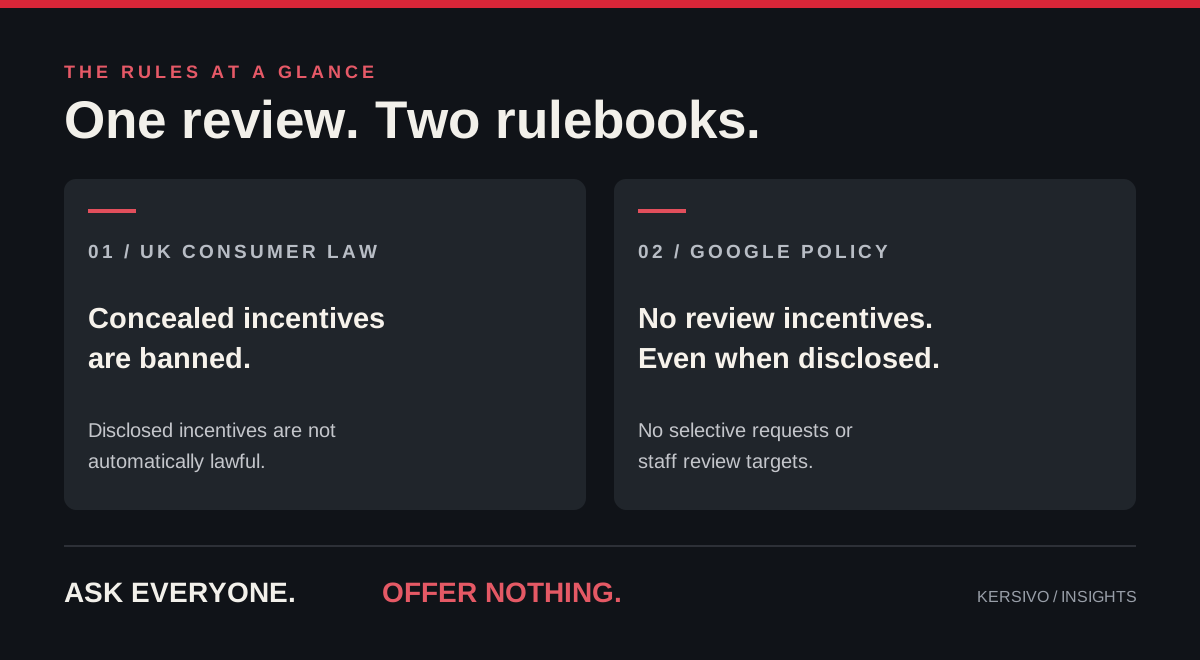
A detail is worth noticing. The Act’s specific ban is on reviews that conceal an incentive. A disclosed incentive isn’t automatically banned, but that doesn’t make it automatically lawful either. If the incentive, or the way reviews are then presented, gives people a misleading picture, other parts of consumer law can still apply. You could read the Act as permission to offer “£2 off your next cut for a review”, as long as it’s labelled. On Google, that reading is a mistake in any case.
Rulebook two: Google’s policy
Google’s Maps user-contributed content policy is stricter than the law. It says merchants may not “offer incentives – such as payment, discounts, free goods and/or services - in exchange for posting any review”. It doesn’t matter whether you disclose the incentive. Google lists further practices it doesn’t allow:
- discouraging negative reviews, or “selectively” asking only happy customers for reviews (often called review gating);
- requiring or pressuring customers to leave a review while they’re still on the premises;
- asking staff to collect a set number of reviews, or reviews that name a particular staff member;
- reviews based on a conflict of interest, such as those from current or former staff or family.
Google says content that breaks these rules is removed, and its Business Profile help page warns of restrictions on profiles that break its policies. For a shop whose new clients mostly find it through Maps, losing reviews or getting a restricted profile does more damage than most fines would.
Put the two rulebooks side by side and the safe area is clear:
| Practice | UK law (DMCC Act and wider consumer law) | Google policy |
|---|---|---|
| Asking every client for an honest review | Allowed | Allowed |
| Discount or freebie for a review, hidden | Banned: concealed incentivised review | Not allowed |
| Discount or freebie for a review, disclosed | Not banned outright, but not automatically lawful; can still mislead | Not allowed |
| Asking only clients who seemed happy | Risky: can make the published picture misleading | Not allowed |
| Staff or family reviewing the shop as if they were ordinary clients | Likely fake or misleading if the connection is hidden | Not allowed (conflict of interest), even if disclosed |
| Bonus for a barber who gathers the most reviews | Not an incentive to the reviewer in itself; becomes one only if passed on to clients | Not allowed (staff targets) |
| Replying publicly to bad reviews | Allowed | Encouraged |
The table isn’t legal advice, and the boundary cases need care. Staff reviews raise three separate questions: whether the review reflects a genuine experience, whether a commercial connection is hidden from readers, and whether Google treats it as a conflict of interest. A barber’s honest review of their own workplace can fail the last test even if it passes the first. The practical rule is simple: ask everyone, offer nothing, and accept whatever comes back.
Why “ask everyone” also works commercially
This can look like a compliance tax. In fact, the honest version is also the one that gets you more reviews, for a reason that’s easy to miss.
Many satisfied clients never leave a review, often because nobody asked them. A client with a grievance has a reason to write without being asked; a contented one may not. A shop that never asks therefore ends up with an unrepresentative sample: a few angry voices and a few loyal fans. Asking every client doesn’t tilt that sample towards praise. It fills in the silent majority. For a shop that cuts well, that majority is mostly positive anyway. Gating tries to fake a result that honest asking would mostly deliver on its own.
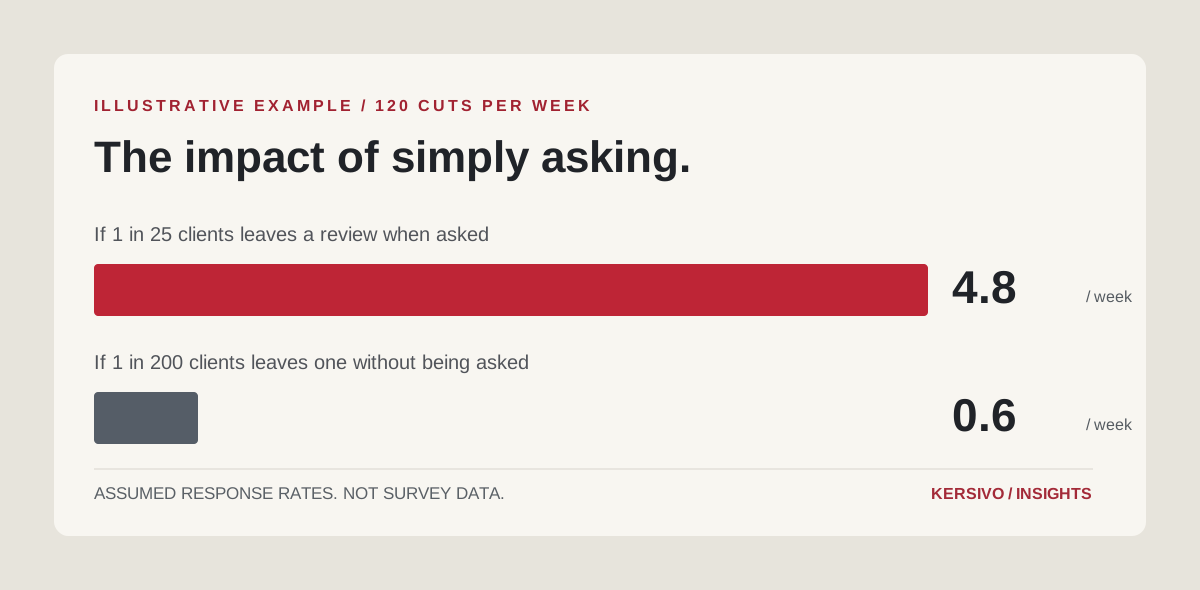
Here’s an illustrative example (assumed rates, not survey data; we found no reliable data on barbershop review rates). A shop does 120 cuts a week. If 1 in 25 clients reviews when asked, that’s about 5 reviews a week, or roughly 250 a year. If 1 in 200 reviews without being asked, it’s under one a week. The exact rates will differ in every shop. What matters is the gap between them, and the gap comes from asking, not from discounts.
The habit that holds up
A system that works on a busy Saturday has to be boring. Four parts are enough.
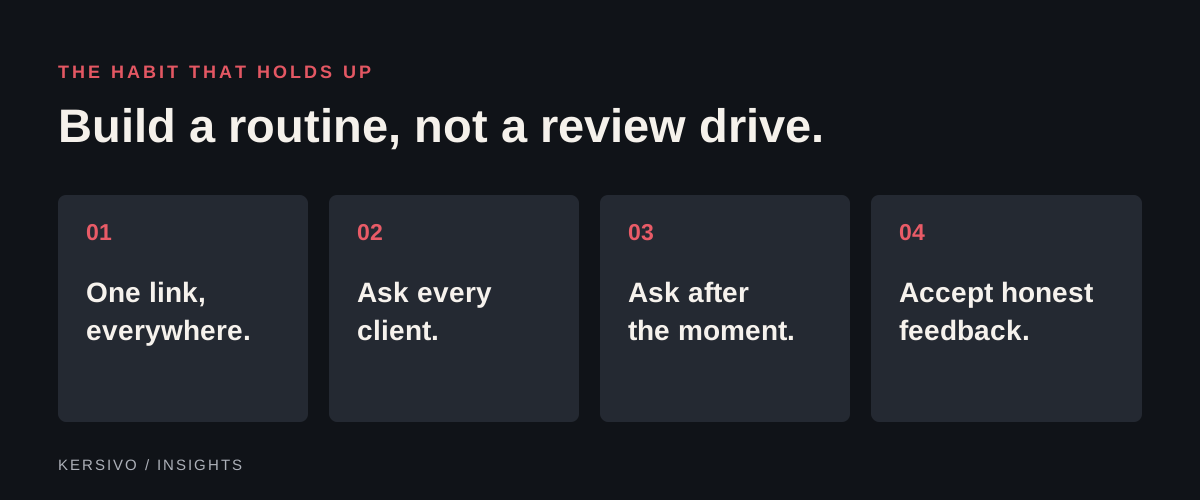
1. One link, everywhere. Google Business Profile lets you create a review link or QR code from your profile. Use the same link in your post-appointment message, on a small card at the till and on your booking confirmation. Everyone gets the same ask. That’s both the fair approach and the easy one.
2. Ask after the moment, not during it. Google’s policy is against pressure on the premises. You’re allowed to mention reviews at the chair, but don’t stand over someone while they type. A short message a few hours after the cut, with the link, keeps you clear of the rule and is easier for the client than an awkward request at the mirror. We found no evidence on which works better for barbershops, so test it in your own shop.
Before you send review requests by text or email, work out what the message is for. The ICO’s guidance treats promotional messages as direct marketing, and a request that promotes your business can count even without an offer in it. If it’s marketing, the electronic marketing rules apply: you need consent, or the “soft opt-in” conditions for existing clients, and an opt-out in every message. Decide the purpose and the legal basis first, rather than assuming a review request is exempt.
3. Never pay for reviews, and don’t set review targets for your team. Paying a client for a review and paying a barber a bonus for gathering reviews are different things. The bonus isn’t an incentive to the reviewer, but Google specifically rules out staff review targets and requests to name a staff member. If you want to recognise good work, reward rebooking or retention. Those numbers say more about a barber’s chair than review counts do.
4. Reply like a professional, especially to the bad ones. Google advises short, specific, non-promotional replies and private follow-up on complex complaints. A calm reply to a 2-star review is read by everyone who comes after. It may do as much for a stranger’s trust as another “great fade, cheers”.
The counterargument: stars don’t fill chairs, cuts do
There’s a fair objection. A barbershop’s reputation is built in the chair and in the conversations clients have at work. Reviews only record it. Some well-run shops have modest review profiles and full diaries thanks to word of mouth.
That’s true, and it’s a useful limit on the advice. Reviews matter most at the edge of your audience: new residents, visitors, people whose regular barber has retired. These are people with no friend to ask. For a shop that’s always fully booked with regulars, a review drive is a low priority. For a shop with gaps on Tuesdays, it matters more, because new clients searching for “barber near me” are exactly who can fill them.
There’s a second objection: asking everyone means inviting criticism. It does. Google itself says a mix of positive and negative feedback often feels more trustworthy. A profile of 300 reviews with a few honest grumbles and good replies looks like a real business. A profile of 40 identical five-star reviews can look like the opposite.

What to measure
You don’t need software to see whether this works. Once a month, write down three numbers: total review count, average rating, and the number of new clients who say they found you on Google (ask at first booking). The first two show whether the habit is working. The third is the only one that pays bills.
Keep that distinction clear. A review is not revenue. A new client who returns and rebooks is. The value of a review is how many strangers it turns into first visits, and that value is gone if the first visit doesn’t lead to a second.
The short version
- Ask every client, the same way, after the appointment.
- Offer nothing for a review. Google bans incentives even when disclosed.
- Don’t screen for happy clients, don’t set staff review targets, and don’t let staff or family review the shop.
- Reply to criticism calmly and briefly.
- Track new clients from Google, not just stars.
The law sets the minimum. Google’s policy is the stricter of the two, and for most shops, asking everyone honestly is also the approach most likely to build a steady, credible record.
References (checked 16 October 2026; items 6–8 added in v2)
- Digital Markets, Competition and Consumers Act 2024, Schedule 20, paragraph 13 (in force 6 April 2025, SI 2025/272). legislation.gov.uk/ukpga/2024/13/schedule/20/paragraph/13 (accessed 16 Oct 2026).
- Competition and Markets Authority, Fake reviews guidance (CMA208), 4 April 2025. gov.uk/government/publications/fake-reviews (accessed 16 Oct 2026).
- Google, Maps User Generated Content Policy: Prohibited & restricted content. support.google.com/contributionpolicy/answer/7400114 (accessed 16 Oct 2026).
- Google Business Profile Help, Tips to get more reviews. support.google.com/business/answer/3474122 (accessed 16 Oct 2026).
- Google Business Profile Help, Tips to improve your local ranking on Google (Prominence). support.google.com/business/answer/7091 (accessed 16 Oct 2026).
- Google Business Profile Help, Tips to improve your local ranking on Google (relevance, distance, prominence) — https://support.google.com/business/answer/7091
- CMA, Short guide for businesses publishing consumer reviews — https://www.gov.uk/government/publications/fake-reviews/short-guide-for-businesses-publishing-consumer-reviews-and-complying-with-consumer-protection-law
- ICO, Direct marketing guidance: identify direct marketing — https://ico.org.uk/for-organisations/direct-marketing-and-privacy-and-electronic-communications/direct-marketing-guidance/identify-direct-marketing