
How to Get More Barbershop Clients Locally: Price the Channel Before You Pick It

Most advice on getting more clients is a list of channels: Instagram, leaflets, Google, a referral scheme, a deal site. The lists aren’t wrong. What they leave out is the question an owner should ask first. What does a new client cost through this channel, and how many of them come back?
A barbershop is a local business with a short radius. Most clients live, work or commute within a short trip of the door. So “more clients” doesn’t need a big marketing plan. It’s more like accounting. Each channel brings strangers in at some cost in money, time or margin. The ones worth repeating bring in strangers who turn into regulars.
A quick way to compare channels
Here’s a framework, not a benchmark. The numbers below are illustrative.
Say a regular visits every five weeks and spends £22 each time. That’s about ten visits a year. Ignoring costs, one client who stays a year is worth around £220 in revenue. The contribution is lower: take off product, card fees and any pay that varies with the cut, such as commission. A fixed wage isn’t deducted, because you pay it whether the client comes or not, unless the extra client means paying for extra hours. The profit is lower again, after rent, rates and everything else. Keep these three apart. A channel can bring in plenty of revenue and still make a loss.
Now compare two channels. It helps to separate three costs, because each one divides by a smaller number:
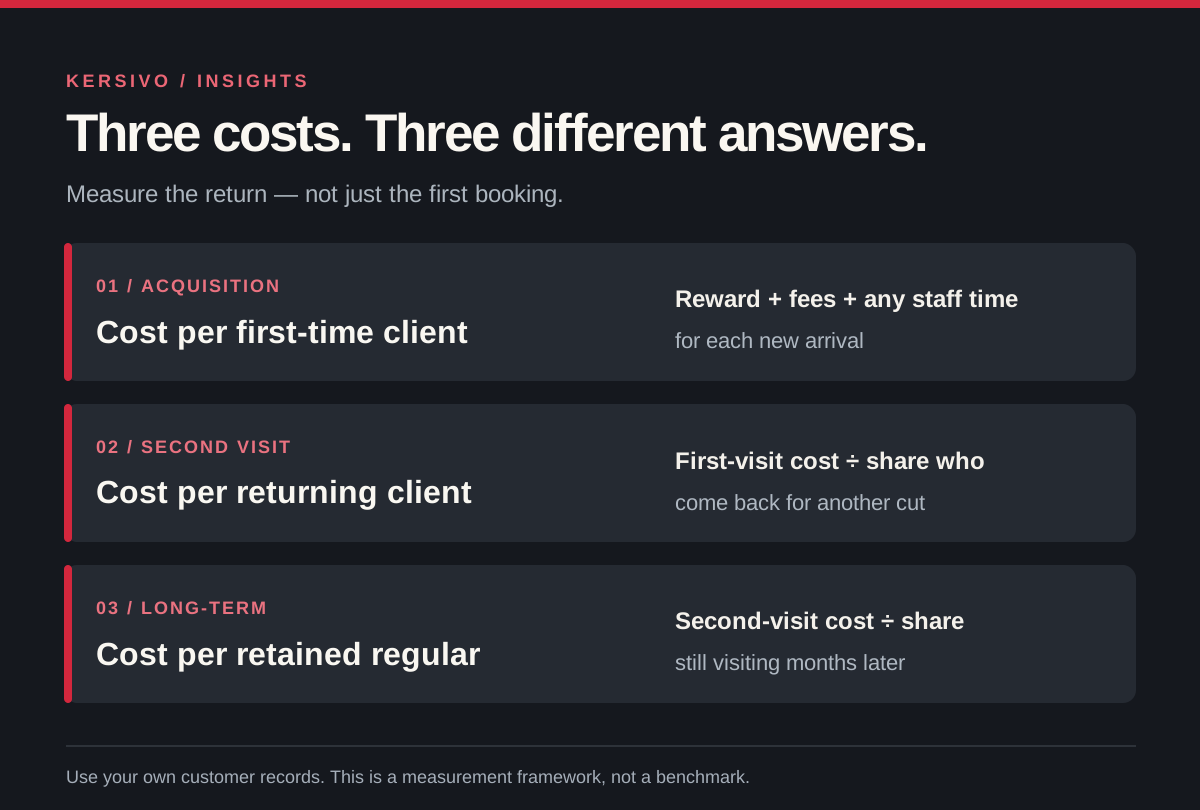
- cost per first-time client = (discount or reward + platform fee + any staff time you’d count) ÷ 1;
- cost per second-visit client = cost per first-time client ÷ the share who come back for a second visit;
- cost per retained regular = cost per second-visit client ÷ the share of those who are still coming months later.
| Illustrative, per first visit | Channel A: deal-site offer | Channel B: referral card |
|---|---|---|
| Discount or reward | £12 off the client’s first cut | £5 off for the referrer, paid only after the friend’s visit |
| Platform fee | whatever the site charges (shown here as £0) | none |
| Cost per first-time client | £12 | £5 |
| Share who come back for a second visit (assumed) | 1 in 5 | 1 in 2 |
| Cost per second-visit client | £12 ÷ 0.2 = £60 | £5 ÷ 0.5 = £10 |
Staff time is left out for both. If the deal site charges a fee or commission, or the referred friend also gets a discount, add it to the first line. Cost per retained regular needs one more number you can only get from your own records: how many second-visit clients are still coming after six or twelve months. If that share is the same for both channels, the gap between them stays the same.
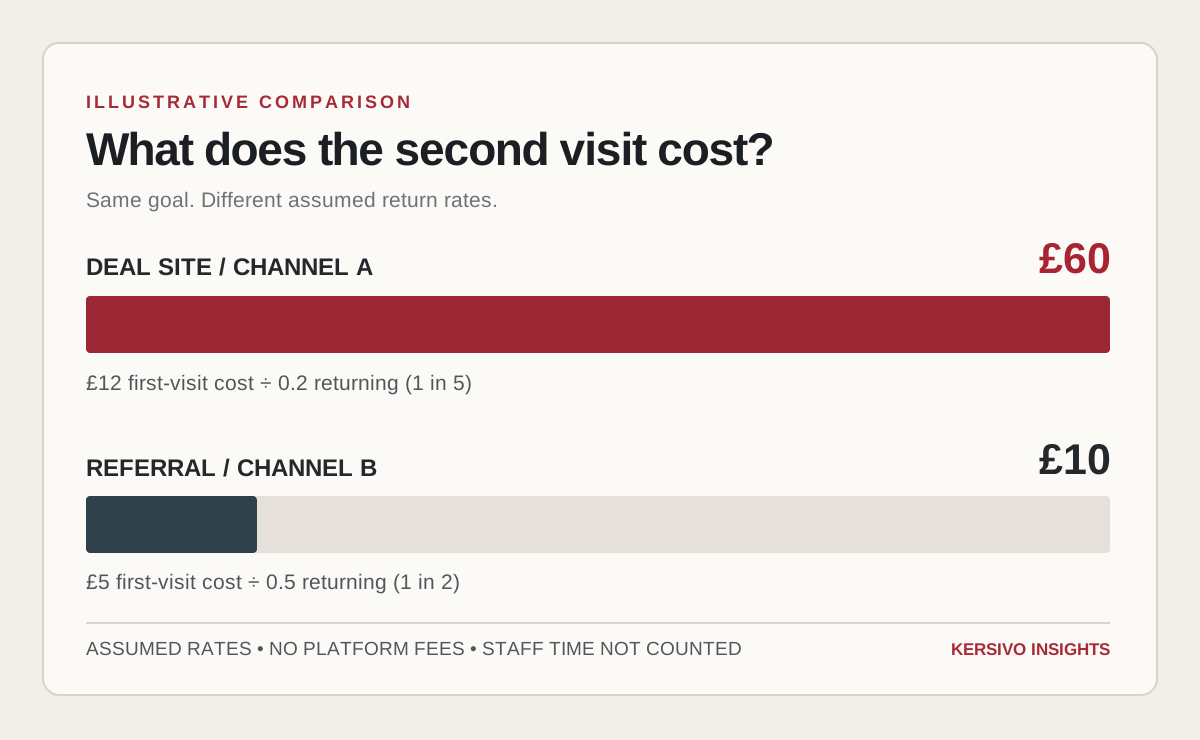
The return rates are assumptions to illustrate the point. Here is how wrong they could be before the conclusion flips. If Channel A’s rate is really twice as high (2 in 5) and Channel B’s really half as high (1 in 4), A costs £12 ÷ 0.4 = £30 per second-visit client and B costs £5 ÷ 0.25 = £20. B is still cheaper. That holds only on these numbers: with no platform fee and equal staff time, and as long as any discount for the referred friend stays below £2.50, because (£5 + £2.50) ÷ 0.25 = £30. Change the inputs and the answer can change, so run your own.
That’s the main idea of this article. The other sections apply it to the channels a local shop actually has.
1. The clients you already have
Often the cheapest new client comes through an existing one. A referral scheme only needs three things: a reason to mention you, something to hand over, and a reward that arrives after the friend’s visit, not before.
How you run it matters legally. The ICO’s guidance on the Privacy and Electronic Communications Regulations (PECR) says that if you ask people to forward your marketing message to friends, you are “instigating” that message, so the electronic marketing rules still apply. The ICO advises against asking customers for their friends’ contact details for marketing. In practice, a physical card handed over at the mirror, or a code the client shares themselves in conversation, is cleaner than a “forward this text to three mates” campaign.
The same guidance covers lapsed clients. Under the “soft opt-in”, you can text or email your own previous customers about similar services, provided you gave them a clear chance to opt out when you collected their details and do so again in every message. A short “we haven’t seen you since spring, here’s the booking link” to clients who didn’t opt out costs almost nothing to send and reaches people who already know the chair. It does fail if your contact records never offered an opt-out. Note that the ICO says this guidance is under review after the Data (Use and Access) Act, so check it again before you build a routine around it.
2. Being findable: the Google profile

When someone types “barber near me”, Google says local results depend on three things: relevance, distance and prominence. You can’t move your shop, so distance is fixed. Relevance is mostly housekeeping: the correct category, accurate opening hours (including bank holidays), services listed in plain words, and current photos. Prominence builds up over time, and Google’s own help pages say it includes how many reviews you have and links to your business from elsewhere on the web.
This channel has unusual economics. The upfront cost is time, not money, and it doesn’t stop working when you stop paying, unlike an ad. Its weak point is the step after the search. A stranger who finds you and then can’t easily book or see a price often moves on to the next listing. How you handle reviews matters here too: the rules on incentives and selective asking are stricter than many owners expect.
3. The street
Leaflets, A-boards and window displays can still work for a business whose customers walk past every day. They’re also the channels most often done badly.
One legal point first, for England and Wales. Under section 94B of and Schedule 3A to the Environmental Protection Act 1990, added by the Clean Neighbourhoods and Environment Act 2005, a council can designate areas where handing out free printed matter without its consent is an offence if the distributor knows the land is designated. Paying or getting someone else to hand them out there is also an offence, unless you took reasonable steps to make sure they didn’t distribute on designated land. Councils publish these zones and the application process. Some charge a fee and attach conditions, and the published guidance from councils such as Preston says letterbox delivery isn’t covered by the restriction. Before you pay someone to hand out flyers on the high street, check your council’s website.
On the economics: a leaflet with a vague message (“Quality cuts, friendly service”) gives a stranger no reason to switch. A leaflet that answers the questions a new client actually has works harder. What does a cut cost? Can I just walk in, or do I need to book, and how? When are you open late? The same goes for the window. The board outside is often the first price list a passer-by sees.
4. Neighbours with your clients
The gym down the road, the office building around the corner and the student accommodation nearby all have people who need a haircut every few weeks. A simple arrangement with a local business can bring a steady trickle of people who live or work within walking distance: a card on their noticeboard, or a staff offer for their team. Those clients may be more likely to become regulars, because the shop is convenient for them.
Measure it like any other channel. If it brings three new clients a month and two stay, at little cost, that compares well with many paid options. If it brings none after two months, stop.
The counterargument: “I’m full; I don’t need clients”
Some owners will say marketing is for shops that cut badly. A good barber gets busy by word of mouth, and chasing strangers gets you discount-hunters who never come back.
There’s something in this. Channel A in the table above is a fair description of what discount marketing often does. A shop that’s genuinely full from Thursday to Saturday is right to ignore most of this.
But “full” usually means full at the peak. A typical diary has quiet mid-week mornings, and those are the gaps new local clients can fill, especially people with flexible hours: shift workers, students, retired people. The case for growing the client base isn’t about volume. It’s about evening out the week, and about having a replacement ready when regulars move away, as some always do.
What to track
The most useful numbers are simple:
- Source for every new client (“How did you find us?” at first booking).
- Second visit: did they come back within a window that suits your shop, often a little longer than your regulars’ usual gap? Count a month’s new clients only once that window has closed for the last of them, then divide returns by the number of new clients in that month.
- Cost of the channel per month, in money and time.
Once the window has closed for a few months’ worth of new clients, divide each channel’s cost by the number of its clients who came back. Keep the channels with a low figure and stop the others.
The short version
- Work out what a regular is worth to you: revenue, then contribution.
- Judge each channel by cost per returning client, not cost per first visit.
- Start with referrals and lapsed clients. Keep it within PECR: no forwarded campaigns, and give an opt-out every time.
- Tidy your Google profile. It’s cheap and it keeps working.
- Check your council’s leafleting zones before you hand out flyers.
- Try partnerships with neighbours whose people already pass your door, and measure them.
None of this is complicated. It needs the same habit a good barber already has: noticing who sits in the chair and why they came back.
References
- Information Commissioner’s Office, Electronic mail marketing (Guide to PECR; regulation 22; soft opt-in; viral marketing). ico.org.uk (accessed 16 Oct 2026). Note: under review following the Data (Use and Access) Act.
- Environmental Protection Act 1990, Schedule 3A (free distribution of printed matter on designated land; England and Wales). legislation.gov.uk/ukpga/1990/43/schedule/3A (accessed 16 Oct 2026).
- GOV.UK, Council powers to control leafleting causing a litter problem. gov.uk/guidance/council-powers-to-control-leafleting-causing-a-litter-problem (accessed 16 Oct 2026).
- Preston City Council, Guidance notes for leaflet distribution (example of a council scheme). preston.gov.uk (accessed 16 Oct 2026).
- Google Business Profile Help, Tips to improve your local ranking on Google (relevance, distance, prominence). support.google.com/business/answer/7091 (accessed 16 Oct 2026).
- Environmental Protection Act 1990, s. 94B (gives effect to Schedule 3A; inserted by the Clean Neighbourhoods and Environment Act 2005, s. 23). legislation.gov.uk/ukpga/1990/43/section/94B (accessed 16 Oct 2026).