
Is an Apprentice Barber Worth It? The 2026 Numbers for Small Shops in England

Apprenticeship funding described here applies in England. Figures checked on GOV.UK on 16 October 2026.
Every experienced barber was a beginner once, and most learned in someone else’s shop. Taking on an apprentice is the oldest way the trade renews itself. For a small shop, it’s also a business decision with real costs: wages, training time and a chair that earns less while someone learns.
Two things changed this year that make the decision worth revisiting. From 1 August 2026, the government pays all training and assessment costs for apprentices aged 16 to 24 at employers that don’t pay the apprenticeship levy, which in practice means most barbershops (the levy applies to employers with a pay bill over £3 million). And from 1 October 2026, those employers can get a hiring payment of up to £2,000 for a new apprentice aged 16 to 24. The money on offer is now larger than many owners assume. The cost that matters most isn’t one the government pays.
What’s on offer
The barbering apprenticeship is the Level 2 Barbering Professional standard, with a typical duration of 18 months and a government funding band of up to £9,000 for training and assessment. For a non-levy employer taking on an apprentice aged 16 to 24, the government pays that cost in full, up to the band maximum. For apprentices aged 25 or over, the employer pays 5% and the government pays 95%.
On top of training, GOV.UK lists several payments:
- a hiring payment of up to £2,000 for non-levy employers. The apprentice must be aged 16 to 24 at the start, have an apprenticeship agreement with a practical start date on or after 1 October 2026, be on the PAYE scheme linked to your apprenticeship service account, and not have worked for you for more than 90 days before starting. It’s passed on by the training provider in two £1,000 instalments, when the apprentice is still in learning at 90 days and at 365 days;
- a separate £1,000 additional payment for apprentices aged 16 to 18, or 19 to 24 with an education, health and care plan or who are or have been in care, also paid in two instalments. Government guidance treats it as separate from the hiring payment, so an eligible employer can receive both;
- no employer National Insurance on earnings up to the upper secondary threshold (£50,270 a year) for apprentices under 25.
For a 17-year-old apprentice starting after 1 October 2026, that could mean up to £3,000 in payments, free training and no employer’s National Insurance. Eligibility conditions apply to each, the second instalments depend on the apprentice still being in training, and the training provider confirms what you’ll get.
What it costs
The apprentice rate of the National Minimum Wage is £8.00 an hour from April 2026. It applies to apprentices under 19, and to those 19 or over in the first year of their apprenticeship. After that, they’re entitled to the normal minimum wage for their age.
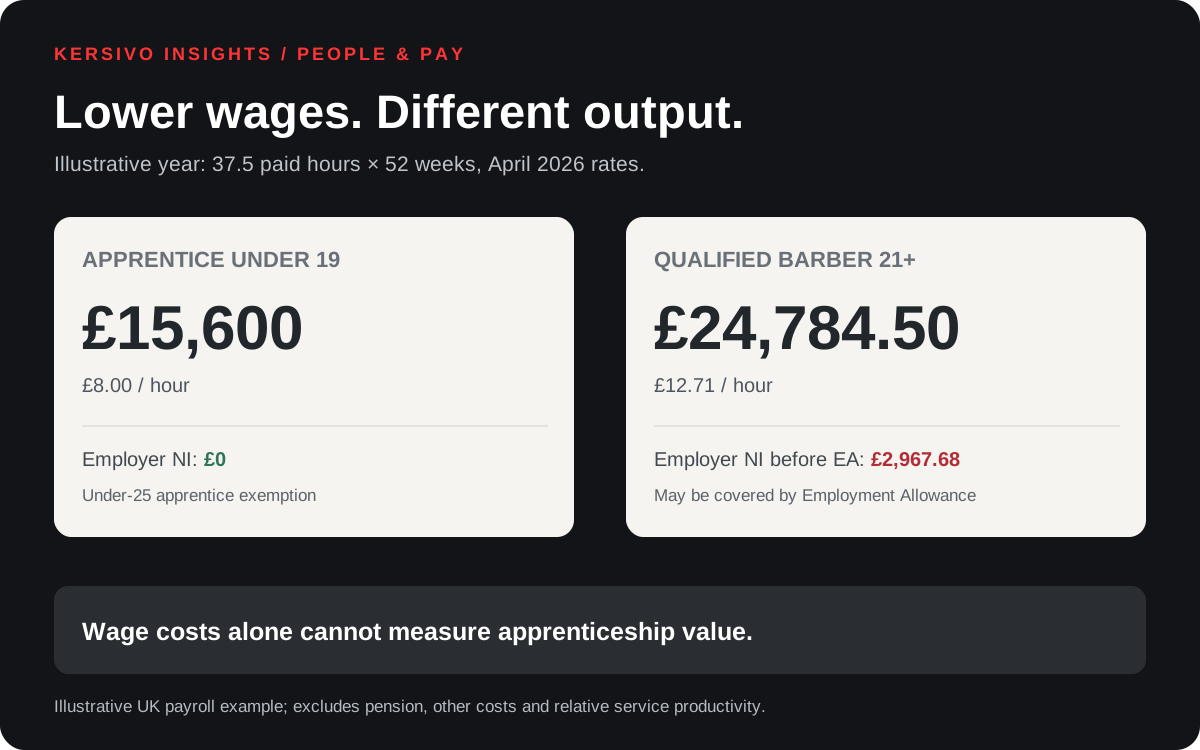
Here’s a hypothetical comparison, to show the shape of the numbers rather than any real shop’s costs. Both work 37.5 hours a week and are paid for all 52 weeks, so the annual figures already include paid holiday; don’t add holiday pay on top.
| Cost (hypothetical, per year) | Apprentice under 19, £8.00/h | Qualified barber 21+, £12.71/h |
|---|---|---|
| Gross wages (37.5h × 52 weeks) | £15,600 | £24,784.50 |
| Employer’s National Insurance, before Employment Allowance | £0 (under 25, below £50,270) | (£24,784.50 − £5,000) × 15% = £2,967.68 |
| Workplace pension | applies to both if eligible; not shown | applies to both if eligible; not shown |
The £2,967.68 is the barber’s National Insurance before Employment Allowance. Eligible employers can reduce their total employer’s National Insurance bill for the year by up to £10,500. It’s an employer-level allowance, not a per-employee one. In a small shop whose whole payroll’s employer’s NI comes to less than £10,500, the allowance might cover all of it, so taking on the barber may add nothing in cash NI. In a shop that has already used the allowance on other staff, the full £2,967.68 is extra. Not every employer qualifies; for example, a company whose only employee paying secondary NI is its sole director can’t claim.
On wages alone, the apprentice is much cheaper. But wages are the wrong comparison, because a qualified barber is producing income from the first day and an apprentice mostly isn’t.
The real cost is your time
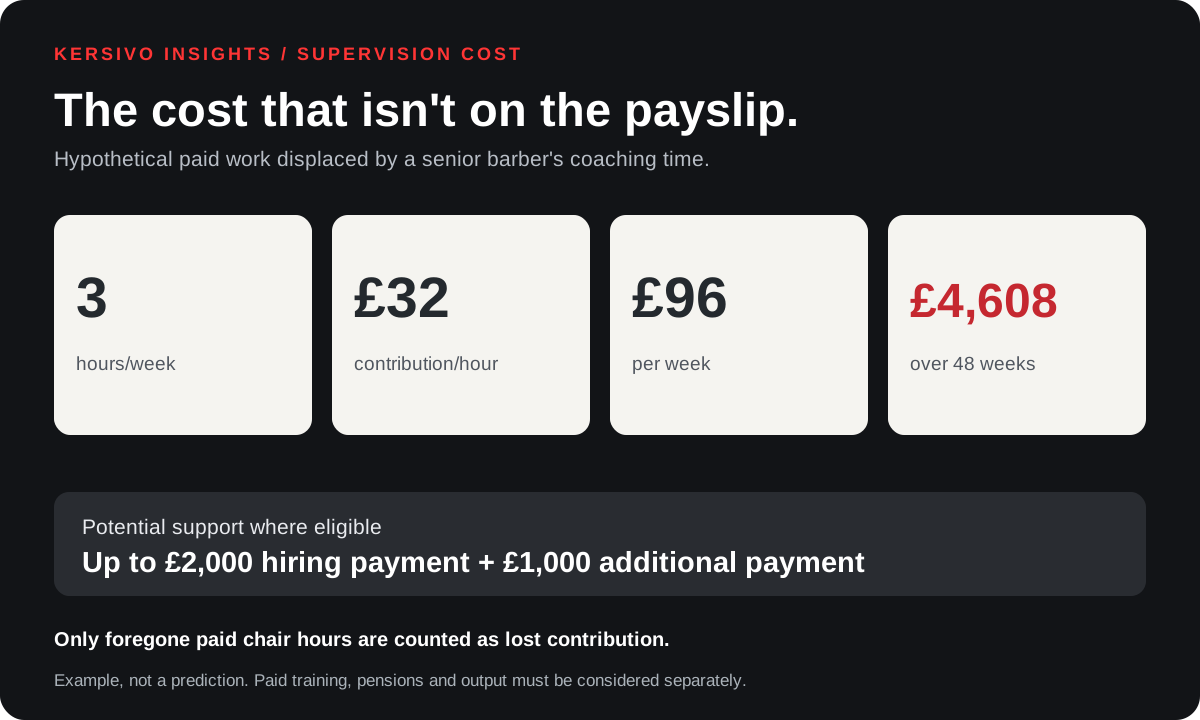
The cost that doesn’t appear in any funding table is supervision. An apprentice learns by watching, practising and being corrected, and the person correcting them is usually the most productive barber in the shop.
Suppose, hypothetically, a senior barber spends three hours a week coaching in time that would otherwise have been booked, and each of those hours would have earned £32 of contribution in the chair. That’s £96 a week, or £4,608 over 48 working weeks. That’s more than the hiring payment and the £1,000 additional payment put together. The cost is real only for coaching that displaces paid work; an hour of teaching in an otherwise empty afternoon costs much less. Your own figure might be higher or lower. The point is that it exists, and it’s easy to leave out.
Apprentices also need a set amount of off-the-job training, such as college days or structured learning, which happens in paid working time. That time is already in the wage figure above; the cost is the work they aren’t doing in those hours, not an extra wage. In the first months, an apprentice may contribute through basic tasks, client care and simpler services, but they won’t fill a diary the way a qualified barber does.
So the honest calculation isn’t “cheap labour versus expensive labour”. It’s whether the shop can carry 18 months of lower output and senior time in exchange for a barber trained in its own standards at the end.
When it makes sense
An apprentice tends to make the most sense in a shop with steady demand and at least one experienced barber who has the time, and the temperament, to teach. It makes much less sense in a shop where everyone is fully booked and nobody can spare an hour, or where the owner works alone and can’t supervise while cutting.
It also makes sense when hiring qualified barbers is the problem. If you’ve struggled to recruit, training someone may be the only reliable way to add a chair. If qualified barbers are easy to find in your area, the case is weaker.
One more factor: retention. An apprentice who qualifies and then leaves takes your 18 months of investment with them. Nothing in the funding rules prevents that. A shop with a clear path from apprentice to employed barber, with better pay and a full column in the diary, is more likely to keep the person it trained.
Shop by shop
For an owner-operator working alone, the supervision cost is the whole problem: every coaching hour is an hour you’re not cutting. It can work, but only with quieter periods to teach in.
For a shop with an employed team, it’s usually the most natural fit. There’s someone to supervise, and the apprentice can become the next employed barber.
For a shop of self-employed chair renters, it’s more complicated. An apprentice must be employed, normally by the shop, and someone has to supervise them. Renters aren’t obliged to train the shop’s apprentice. Any arrangement for them to do so needs agreeing, and it shouldn’t blur the line between renter and employee.

Deciding
Start with the question the funding tables can’t answer: who will teach, and when? If you have a clear answer, the numbers in 2026 are as favourable as they have been for some time, with training paid for and up to £3,000 in payments for an eligible young apprentice. If you don’t, no payment will make the arrangement work. Speak to a training provider about the Barbering Professional standard. Confirm which payments you’d be eligible for, and work out your own supervision cost before you advertise.
References (checked 16 October 2026; items 7–8 added in v2)
- GOV.UK, Employing an apprentice: get funding for apprenticeship training — https://www.gov.uk/employing-an-apprentice/get-funding
- DfE, Apprenticeship funding (from 1 August 2026) — https://www.gov.uk/government/publications/apprenticeship-funding/apprenticeship-funding
- Find apprenticeship training (GOV.UK), Barbering professional (level 2): 18 months, maximum funding £9,000 — https://findapprenticeshiptraining.apprenticeships.education.gov.uk/courses
- GOV.UK, Growth and Skills Levy employer factsheet (hiring payment from 1 October 2026; apprentice NICs relief) — https://www.gov.uk/government/publications/resources-for-promoting-apprenticeships-and-skills/growth-and-skills-levy-accessible-version-of-employer-factsheet
- GOV.UK, National Minimum Wage and National Living Wage rates (April 2026) — https://www.gov.uk/national-minimum-wage-rates
- HMRC, Rates and thresholds for employers 2026 to 2027 (apprentice upper secondary threshold £50,270) — https://www.gov.uk/guidance/rates-and-thresholds-for-employers-2026-to-2027
- GOV.UK, Claim Employment Allowance (up to £10,500; eligibility) — https://www.gov.uk/claim-employment-allowance
- DfE, Apprenticeship technical funding guide from August 2026 (hiring payment instalments at 90 and 365 days; £1,000 additional payments) — https://www.gov.uk/government/publications/apprenticeship-technical-funding-guide/apprenticeship-technical-funding-guide-from-august-2026