
Your Diary Is Full. So Why Isn’t Your Barbershop Making More Money?

A full diary feels like proof that the business works. Every slot taken, clients waiting on the bench, no time for a cup of tea. Then the month closes and the money doesn’t match the effort.
The two aren’t contradicting each other. A full diary tells you how much of your time you’ve sold. It doesn’t tell you what each hour earned. Two shops can be equally busy, with the same chairs, the same opening hours and barbers just as good, and still finish the week with very different amounts left over. The difference sits inside the diary, in which services fill it, how long they really take and the minutes between them that nobody sells.
Busy measures time, not money
Most owners judge a day by how full it was. A more useful figure is what each chair-hour you had available actually earned.
The simplest version is revenue per available chair-hour: takings for the day divided by the hours the chair was open for business. A chair open eight hours that takes £246 earns £30.75 an hour. A better version uses contribution rather than revenue, meaning the price minus the costs that only arise because the service happened, such as products used and the card fee on the payment. Rent, rates, fixed wages and your software subscription are excluded, because you pay them whether the chair is full or empty.
Contribution per chair-hour is the number that tells you whether one kind of booking is worth more to you than another. It also exposes something owners rarely see: services can be equally popular and earn very different amounts of contribution once you divide by the time they take.
The same diary, two different days
The figures below are a hypothetical example, not data about UK barbershops. Prices, times and costs are invented to show the method. Use your own.
Assume each booking is followed by a 5-minute buffer to clean down and reset, products cost between 50p and £1.50 per service, and card payments cost 1.5% plus 20p (check your own provider’s rates).
| Service (hypothetical) | Price | Time incl. 5-min buffer | Contribution per service | Contribution per chair-hour |
|---|---|---|---|---|
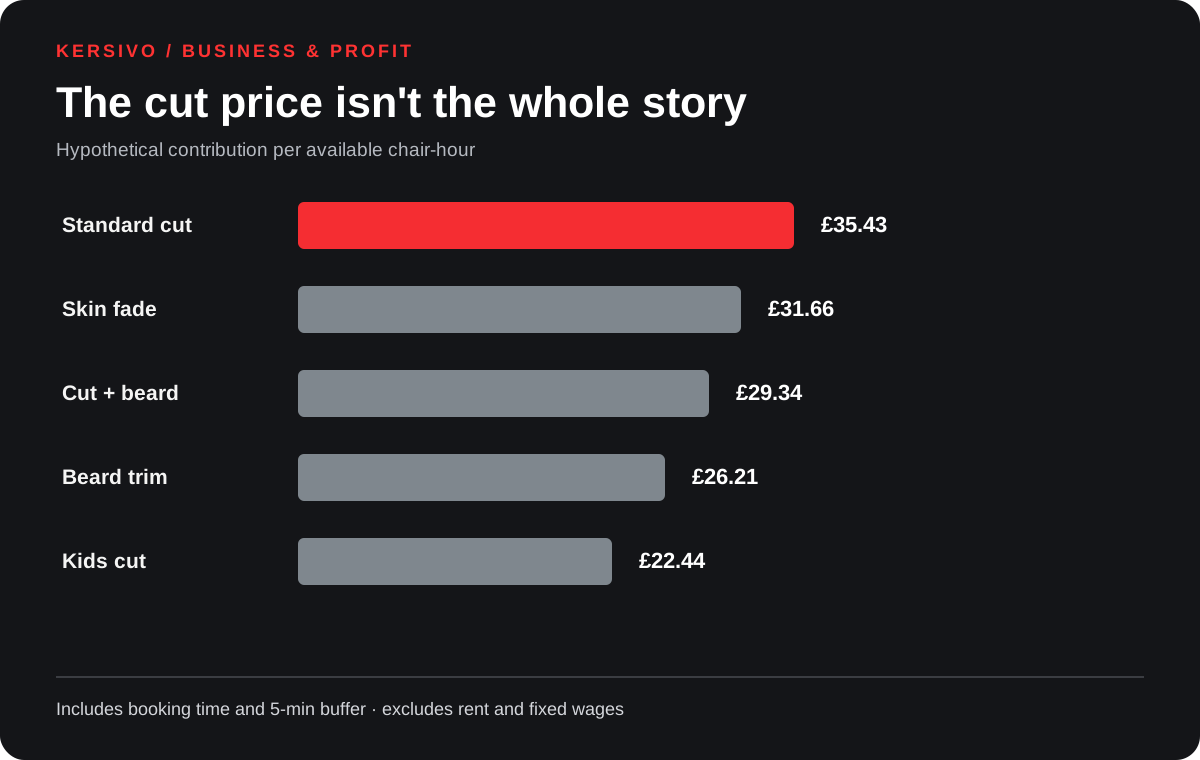
| Standard cut | £22 | 35 min | £20.67 | £35.43 |
| Skin fade | £28 | 50 min | £26.38 | £31.66 |
| Cut and beard | £34 | 65 min | £31.79 | £29.34 |
| Beard trim | £12 | 25 min | £10.92 | £26.21 |
| Kids cut | £14 | 35 min | £13.09 | £22.44 |
The most expensive service isn’t the most valuable use of the chair. In this example, the £22 standard cut earns more per hour than the £34 cut and beard, because it takes little more than half the time. The kids’ cut earns least, mostly because it is priced well below an adult cut but booked for the same length of time.
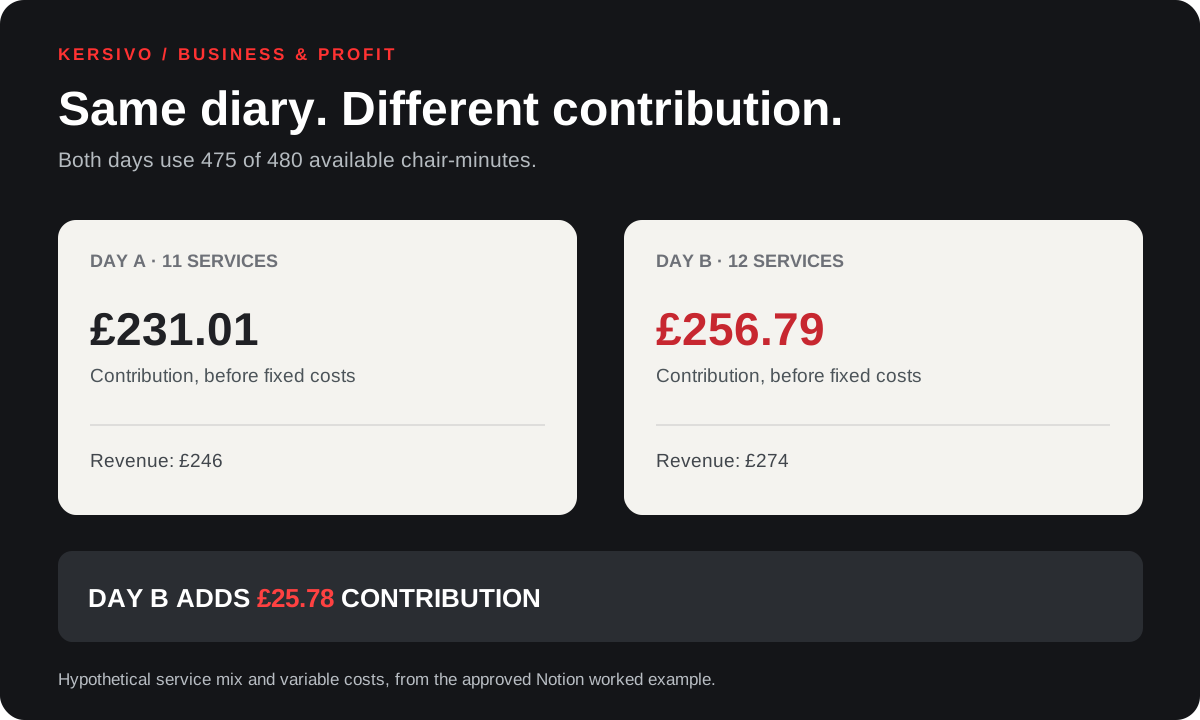
Now fill an eight-hour day two ways. Day A has four skin fades, two standard cuts, four kids’ cuts and one cut and beard. Day B has three skin fades, six standard cuts, two beard trims and one cut and beard. Both use 475 of the 480 available minutes. Both would look completely full on screen.
Day A takes £246 and produces £231.01 of contribution, or £28.88 per chair-hour. Day B takes £274 and produces £256.79, or £32.10 per chair-hour. That is £25.78 more contribution from the same chair, the same hours and a diary that looked identical from across the room. Over a five-day week it comes to £128.90.
Notice what doesn’t change between the two days. If the barber is employed on a fixed wage, they cost exactly the same on Day A as on Day B. At the National Living Wage of £12.71 an hour for workers aged 21 and over, eight hours costs at least £101.68 before employer’s National Insurance, pension contributions and holiday pay. That wage isn’t a cost of any single appointment; it is the cost of having the chair open. Because it is fixed, every extra pound of contribution on Day B raises the shop’s profit for the day by a pound. Contribution isn’t profit, though: profit is what’s left once the fixed costs have been paid.
The minutes nobody sells
The example also hides a cost in plain sight. Day A has eleven bookings, so the 5-minute buffers add up to 55 minutes, nearly an hour of paid chair time in which nothing is sold. Day B has twelve bookings and 60 minutes of buffers. Buffers are often necessary, but they are rarely priced. A short service with a full buffer carries a larger share of unsold time than a long one.
Real diaries leak in other ways too. A 45-minute fade booked into a grid of 30-minute slots can leave a 15-minute gap that no service fits. A long, low-priced service booked into a busy Saturday can push out two shorter, better-paying ones. None of this shows up as an empty slot, because the diary is technically full. It shows up only when you divide what came in by the hours you were open.
Who keeps the difference
How much of this matters to you depends on how the chairs are run, and the real answer is in your agreements, not a general rule.

If you work the chair yourself, or employ barbers on fixed pay, the shop keeps the gain from a better mix and absorbs the loss from a weaker one. If you rent chairs to self-employed barbers for a fixed rent, the mix mostly affects their income, not yours: the rent arrives whatever they book. Under a commission or percentage arrangement, the gain is shared in line with the split, which means both sides have a reason to care about contribution per hour, not just about being busy.
That distinction changes the decisions available to you. You can set prices, service lengths and booking rules for your own chair and for employed staff. With a genuinely self-employed renter, those choices may well be theirs to make, and trying to dictate them could also raise questions about the arrangement itself.
The case for keeping a “loss-making” service
There is a fair objection to all this. Not every service has to earn its keep on its own. A kids’ cut may bring a parent who books a skin fade. A quick beard trim may keep a regular loyal between haircuts. A low-priced weekday service may fill hours that would otherwise sit empty, in which case it adds contribution rather than displacing anything better.
That is the right test. A low-earning service only costs you money when it takes a slot that a better-paying booking would have filled. On a quiet Tuesday afternoon, a £14 kids’ cut is pure gain. On a Saturday morning with a queue, it may be the most expensive thing in the diary.
Working it out for your own shop
Start with your own figures. Take your service list, the price of each, the time you actually block out for it including the buffer, and a rough figure for products and card fees. Divide contribution by minutes and multiply by 60. The ranking will probably surprise you.
Then look at when each service is booked. Your lowest earners per hour don’t need to disappear. They may simply need a different home in the week, a price that reflects the time they take, or a booking length that matches how long they really last. A kids’ cut that takes 20 minutes but is booked for 30 is a diary problem before it is a pricing problem.
Finally, compare contribution per chair-hour with what an open hour costs you. This answers a different question from the ranking above. It tells you whether the chair, across the whole week, earns enough to cover its fixed costs. It doesn’t tell you whether a particular booking is worth taking.
In this example, an employed barber at the National Living Wage costs £12.71 an hour before on-costs. If rent, rates, utilities and the rest add, say, a hypothetical £10 per chair-hour, the chair needs to average at least £22.71 of contribution per open hour across the week to break even, and more once National Insurance, pension and holiday pay are added. Both example days clear that bar comfortably: £28.88 and £32.10 an hour.
The kids’ cut, at £22.44 an hour, sits just below that average. That doesn’t mean it loses money. The wage and the overheads are paid whether the slot is filled or not, so a kids’ cut in an hour that would otherwise stay empty still adds £13.09 of contribution. It becomes a problem only if too much of the week is filled with services below the line, or if it takes an hour a better-paying client wanted.
The decision
A full diary is a good problem, but it isn’t the goal. The goal is a diary that, across the week, earns more contribution per hour than it costs to keep the chair open. Work out contribution per chair-hour for every service, and the decision becomes concrete. Keep the services that pay their way, move the low earners to the hours that would otherwise be empty, and reprice or re-time the ones that take your best hours for the least money. The diary may look exactly as full afterwards. The month-end figure shouldn’t.
References (checked 16 October 2026)
- GOV.UK, National Minimum Wage and National Living Wage rates (April 2026: £12.71, 21 and over) — https://www.gov.uk/national-minimum-wage-rates
- Low Pay Commission, “National Living Wage increases to £12.71 per hour”, 1 April 2026 — https://www.gov.uk/government/news/national-living-wage-increases-to-1271-per-hour
- HMRC, Rates and thresholds for employers 2026 to 2027 (employer Class 1 NICs 15% above £5,000 secondary threshold; Employment Allowance £10,500) — https://www.gov.uk/guidance/rates-and-thresholds-for-employers-2026-to-2027