
The Second Visit: Why a Barbershop’s Growth Is Decided After the First Haircut

New clients are easy to count. They’re visible, they feel like progress, and most marketing is aimed at them. The number that decides whether a barbershop grows is quieter: how many of those new clients come back for a second cut.
A shop that wins plenty of new clients and keeps few of them has to keep running just to stand still. A shop that keeps a high share of first-timers builds a base that does much of the work of refilling the diary. The difference between the two is rarely talent with the clippers. It’s usually what happens between the end of the first appointment and the moment the client decides where to go next time.
A small difference that compounds
Here is a hypothetical shop to show the arithmetic. None of these figures are industry averages; there is no reliable public UK data on barbershop client return rates.
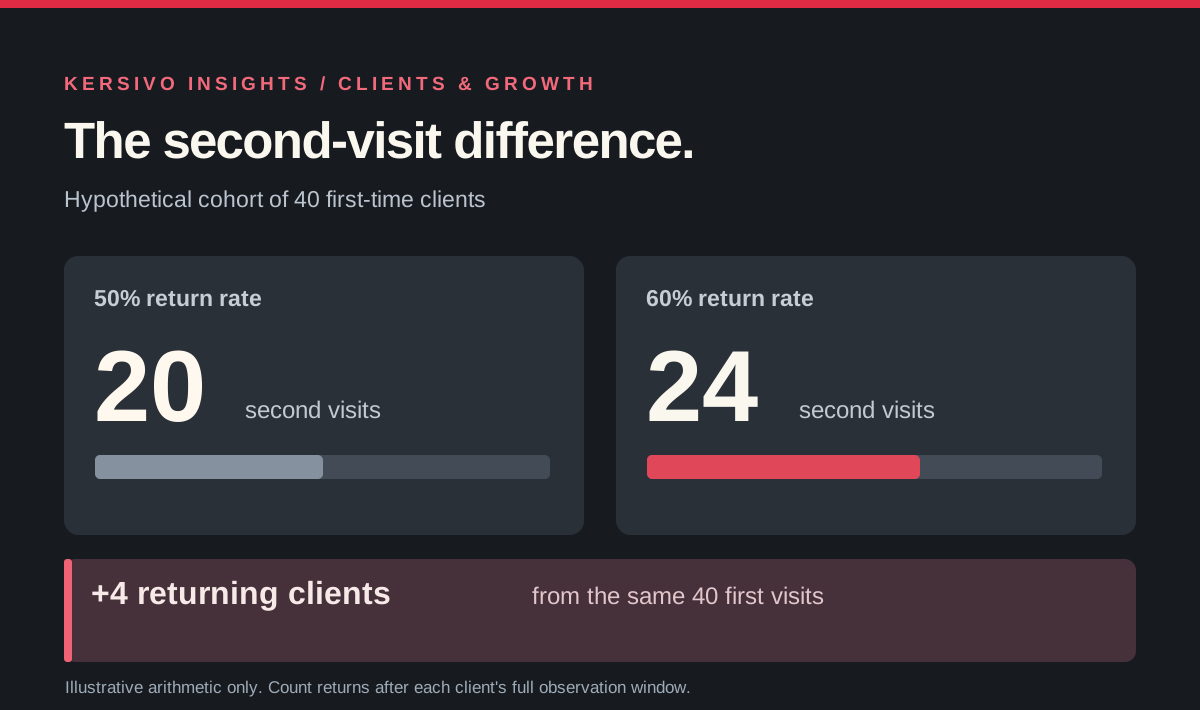
Suppose the shop gains 40 new clients a month, and its second-visit rate rises from 50% to 60%. That’s 24 second visits a month instead of 20: four more.
To turn that into money, the example needs three assumptions, all of them illustrative:
- every one of those four extra clients becomes a regular who comes about every five weeks, ten visits a year at £25, so about £250 a year each;
- nobody drifts away during the year;
- the diary has room for every extra visit, so no other booking is pushed out.
On those assumptions, a year of four extra regulars a month leaves the shop with 48 more regulars than it would have had, worth 48 × £250 = about £12,000 a year in takings from then on. The first year itself brings in less, because clients won later in the year have had fewer visits.
Each assumption flatters the result. If a third of those extra regulars drift away within the year, 32 remain and the figure falls to about £8,000. If the extra visits land on days that are already full, part of it is takings you’d have had anyway from someone else. And it’s takings, not profit: products and card fees come off before anything reaches the bottom line. Treat the £12,000 as an upper bound that shows why the rate matters, not a forecast.
Three numbers to watch
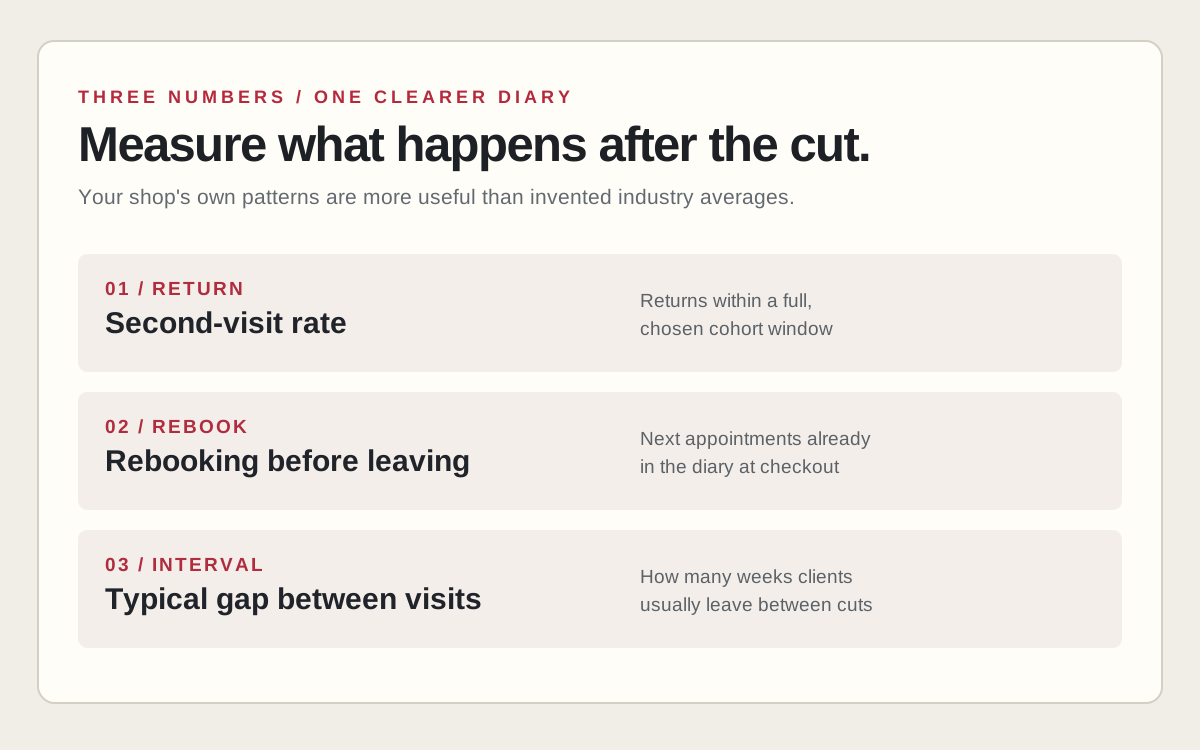
The point of the example isn’t the total. It’s that most shops don’t know their own version of it. Three numbers would tell them.
Second-visit rate. This needs a little care to measure fairly:
- Pick a cohort: every client whose first-ever visit fell in a chosen month. Leave out anyone you know was a one-off, such as a visitor from out of town, but decide that rule in advance and apply it every month.
- Choose a window that fits your shop: a bit longer than the gap your regulars usually leave. If they come every four to five weeks, eight weeks may suit; if your clients are on a six- to eight-week cycle, twelve weeks is fairer. There’s no universal right number.
- Wait until the window has closed for everyone in the cohort, including the client who first came on the last day of the month. Count too early and the rate looks worse than it is.
- Calculate: the number of cohort clients who came back within the window of their own first visit, divided by the number of clients in the cohort. For example, 22 returns from 40 first-timers is 55%.
A second visit isn’t the same as long-term retention. Some clients come back once and then drift. The second-visit rate is a useful early signal because it can be measured quickly; whether clients are still coming after six or twelve months is a separate question worth checking with the same cohort later.
Rebooking at the chair. Of the clients who leave, how many have their next appointment booked before they walk out? A client with a booking in the diary has a reason not to drift to whichever shop is nearest when their hair starts bothering them, though some will still cancel.
Typical gap between visits. If your regulars usually come every four to six weeks, a client who hasn’t been back in ten may have gone somewhere else. That is the moment to notice, not six months later.
None of these need special software. A booking system that keeps client history will make them easier, but a notebook and a monthly count will do.
What actually changes the numbers
There’s no secret here, and no research we could find measures what works best in UK barbershops. But the mechanics are clear enough to reason about.
The simplest lever is asking. A barber who finishes a cut by saying “same again in five weeks? I’ve got the Thursday after next at six” makes rebooking the default. Some clients who meant to book and would have forgotten will simply say yes.

The second is continuity. Many clients come back for a person as much as for a shop. If a new client’s second visit is with a different barber, the shop has to win them all over again. For employed teams, offering the same barber by default is a choice the shop controls. For shops with chair renters, it’s mostly the renter’s relationship, which matters for the next section.
The third is reminders. A message to a client who hasn’t booked, sent when they’re due, can bring some back. It’s here that owners need to be careful.
The rule on messages
The law treats two kinds of message differently, and the difference is in the wording as much as the purpose.
Service messages. A text confirming a booking or reminding a client of an appointment they’ve already made is what the Information Commissioner’s Office calls a service message. It’s administrative, not promotional, so the marketing rules don’t apply, provided it stays purely factual. Add a promotion, such as “book a beard trim too and save £5”, and the ICO treats the whole message as marketing.
Marketing messages. A “you’re due a cut, book now” text to a client with nothing in the diary is encouraging them to buy again. That makes it direct marketing. Under the Privacy and Electronic Communications Regulations 2003, you generally need consent to send marketing by email or text to individuals. The exception, often called the “soft opt-in” (regulation 22(3)), applies only where:
- you got the client’s contact details while selling them a service;
- the message is about your own similar services; and
- you gave them a simple way to refuse when you collected their details, and in every message since.
For many barbershops, a rebooking prompt to a past client can fit that exception if the opt-out was offered at booking and appears in every message. A message promoting someone else’s business doesn’t. The ICO notes that its PECR guidance is under review following the Data (Use and Access) Act 2025, so check its current guidance before setting up automated prompts.
The objection: isn’t this just nagging?
There’s a fair objection. Some clients dislike being asked to rebook on the spot, and a stream of reminders can feel like pressure. Some will leave precisely because a shop starts behaving like a call centre.
That’s why the levers above are light. Asking once at the end of a cut, offering the same barber, and sending a single, well-timed message is very different from a weekly promotional text. The aim is to make it easy for a client who wants to come back to do so, not to talk round a client who doesn’t.
Who owns the relationship
This matters differently by shop.
For an owner-operator, the clients are effectively the business, and retention is one of the most direct routes to a steadier income.
For a shop with employed barbers, the shop holds the booking system and the client records, but clients may follow a barber who leaves. That is a reason to make sure clients feel they belong to the shop as well as to one person.
For shops with self-employed chair renters, renters often build and keep their own client base. The shop benefits indirectly: a renter with a loyal following pays their rent and fills the chair. Who can contact those clients, and whose list they sit on, depends on the arrangement between you. It’s worth being clear about it in writing before it becomes a dispute.
Where to start
Pick a month of first-time clients from long enough ago that your return window has closed for all of them, and count how many came back. That one number tells you a lot about the health of the shop. If it’s high, protect what’s working. If it’s low, start with the simplest change, asking every client before they leave when they’d like to come back, and count again in two months. Growth that comes from clients returning is usually cheaper and steadier than growth that has to be bought fresh every month.
References (checked 16 October 2026; items 3–4 added in v2)
- The Privacy and Electronic Communications (EC Directive) Regulations 2003, reg. 22 (as amended) — https://www.legislation.gov.uk/uksi/2003/2426/regulation/22
- Information Commissioner’s Office, Direct marketing guidance — https://ico.org.uk/for-organisations/direct-marketing-and-privacy-and-electronic-communications/
- ICO, Direct marketing guidance: identify direct marketing (service messages) — https://ico.org.uk/for-organisations/direct-marketing-and-privacy-and-electronic-communications/direct-marketing-guidance/identify-direct-marketing
- ICO, Guide to PECR: electronic mail marketing (notice that guidance is under review after the Data (Use and Access) Act) — https://ico.org.uk/for-organisations/direct-marketing-and-privacy-and-electronic-communications/guide-to-pecr/electronic-and-telephone-marketing/electronic-mail-marketing/