
Do Barbers Need a Website? A Test for Shops That Already Have Instagram and Google
“Do I need a website?” is one of the most common questions barbershop owners ask, and the answers online are almost all yes. Many of them are written by people who sell websites, and so is this one: KERSIVO sells booking software and websites for barbershops. That’s a good reason to work through the question yourself rather than take anyone’s word for it, ours included.
The honest answer is that some barbershops don’t need a website, many need something smaller than they think, and a few are losing clients because they don’t have one. The way to tell which group you’re in is to ask what job a website would do that your Google profile and Instagram account don’t already do.
What the free platforms already do well
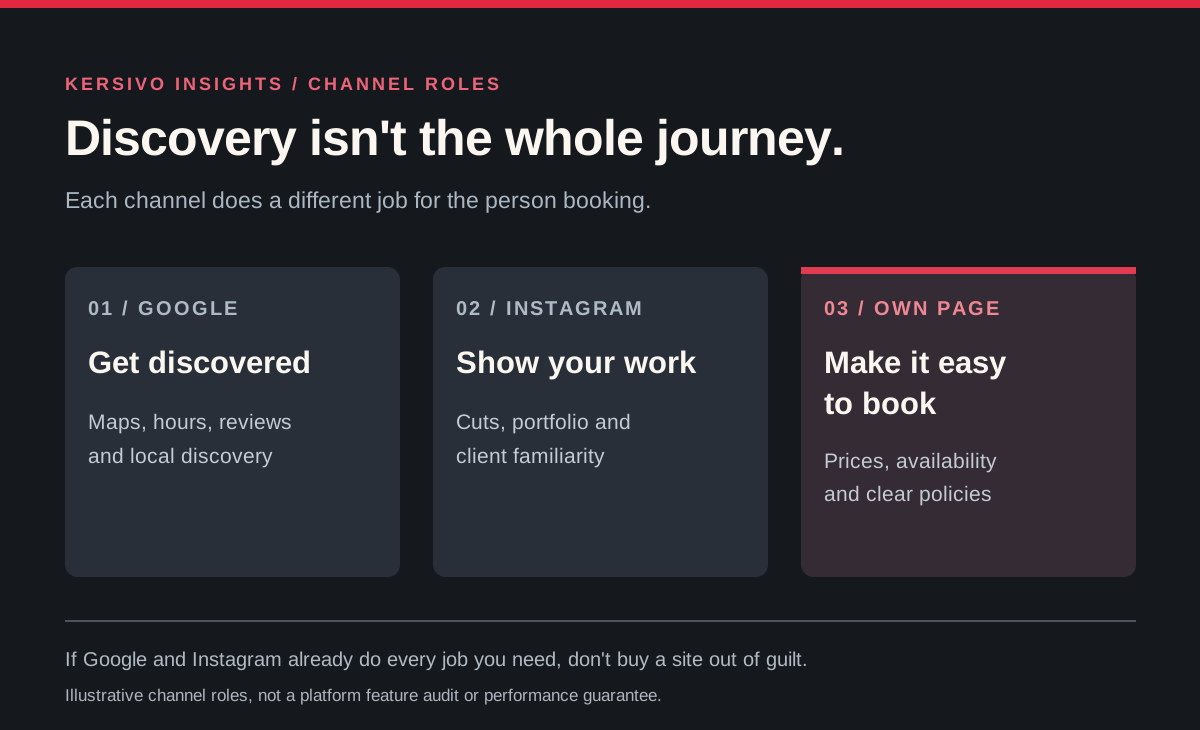
A Google Business Profile is, for many shops, the real front door. It shows up when someone searches “barber near me”. It carries your hours, location, photos and reviews, and Google’s own help pages describe how relevance, distance and prominence decide where it appears in local results. Instagram does something different. It shows your work, gives your barbers a portfolio, and keeps you in front of existing clients between visits.
Between them, these two cover discovery and reputation, and they’re free. If your diary is full of regulars and new clients arrive by word of mouth and Maps, a website may add very little. Don’t let anyone talk you into spending money to solve a problem you don’t have.
Four jobs the platforms do badly
The case for a website rests on jobs the free platforms either do badly or do on someone else’s terms.
1. A page you control. Your Google profile and Instagram account belong to platforms with their own rules, layouts and priorities. You can’t decide what appears next to your listing, how your price list is shown, or what happens if the account is suspended or hacked. A website is the one place online where you decide what’s on the page.
2. Prices and policies in one place. A shop that takes deposits or charges for no-shows needs its terms set out clearly, in a place the client can see before booking. The same applies to prices. Under the Provision of Services Regulations 2009, a service provider must make available the price of a service where it is predetermined, along with its name, address and contact details. One of the ways the regulations allow this is “easily accessible to the recipient electronically by means of an address supplied by the provider”. A short page with your prices, cancellation policy and contact details does this tidily. A pinned Instagram post usually doesn’t.
3. Legal disclosures, if you trade as a company. If your shop is a limited company, the Company, Limited Liability Partnership and Business (Names and Trading Disclosures) Regulations 2015 require it to show its registered name on its websites (regulation 24). Regulation 25 adds the part of the UK where it’s registered, its registered number and its registered office address. This doesn’t oblige you to have a website. But it does mean the one you have needs a correct footer, which many small business sites lack.
4. Booking without a middleman’s shop window. A client who finds you on a marketplace app is browsing a list of your competitors. A client who books through your own page sees only you. That’s partly a cost question, because some platforms charge for new clients, and partly about who the client feels they’re dealing with. You don’t need a full website for this. A dedicated booking page linked from your Google profile and Instagram bio does most of the job.
A simple test
This is a rule of thumb, not a scoring system. It’s a quick way to see whether a website would do a job you actually need done. Answer these four questions honestly:
| Question | If yes | If no |
|---|---|---|
| Do new clients struggle to find your prices or book outside opening hours? | A booking page with prices is worth having | The platforms are probably enough |
| Do you take deposits or charge for no-shows? | You need a clear, linkable policy page | Optional |
| Do you trade as a limited company and already have a site? | Check the footer disclosures now | Not applicable |
| Do most of your new clients come through a marketplace you’d rather not depend on? | Your own booking route is worth building | Lower priority |
If you answered no to all four, a website is probably a nice extra rather than a need. If you answered yes to two or more, a simple site or booking page may be worth testing. One yes can be enough if it’s a big problem for your shop.
How much website you actually need
When owners hear “website”, they often picture a design agency, a photo shoot and a monthly retainer. Most barbershops need one of three much smaller things:
- A single page: name, address, hours, a price list, the booking link, and the cancellation policy. This covers almost every job above.
- A booking page that doubles as a website: many booking systems include a public page with services, prices and availability. For a lot of shops this is the website.
- A small branded site on your own domain: may be worth it when the brand matters, for example if you have several barbers with their own followings, a second location, or a retail range, and you want your web address to be something clients remember.
The difference between these isn’t only cost. A marketplace listing puts you inside someone else’s directory, next to other shops. A hosted booking page is yours to fill in, but it sits on the provider’s address and design. A site on your own domain gives you the most control over how the brand looks, and the address stays yours if you change booking provider later. Whether that control is worth paying for depends on the shop. For one example of the last two options, KERSIVO offers a free hosted booking page on its Starter plan and a branded site on your own domain on its paid plan. Other providers offer similar things.
Whatever you choose, judge it by the same standard: does it make it easier for a stranger to see a price and book a chair? Design that doesn’t help with that is decoration.
The counterargument: “nobody visits barbershop websites”
There’s a strong objection here. Clients search on Google, scroll Instagram and book in apps. Some owners will tell you their website gets a handful of visits a month, and that’s probably true for plenty of shops.
But low traffic doesn’t necessarily mean the site does nothing. A website’s job is often to be the place a link points to. It’s where the Google profile’s website button goes, where the Instagram bio sends people, and where your booking confirmation points for the cancellation policy. A client may see it for thirty seconds, just before deciding to book. Measuring it by visits is a bit like judging a shop’s sign by how often people stare at it.
The objection does carry an important limit. If a site has no prices, no booking and no policies, then nobody visiting it really is the right outcome. The page has nothing a client needs.
What it costs, in the right terms
Keep three numbers apart. The cost of a site is its yearly fee, plus any extras such as a domain name or photos, plus your time. The revenue it might bring is the bookings that come through it that wouldn’t otherwise have happened. That’s hard to measure and easy to overstate, because many clients who book through a website would have found you anyway. The contribution is what’s left after the costs of those cuts.
A rough break-even for the client-winning side:
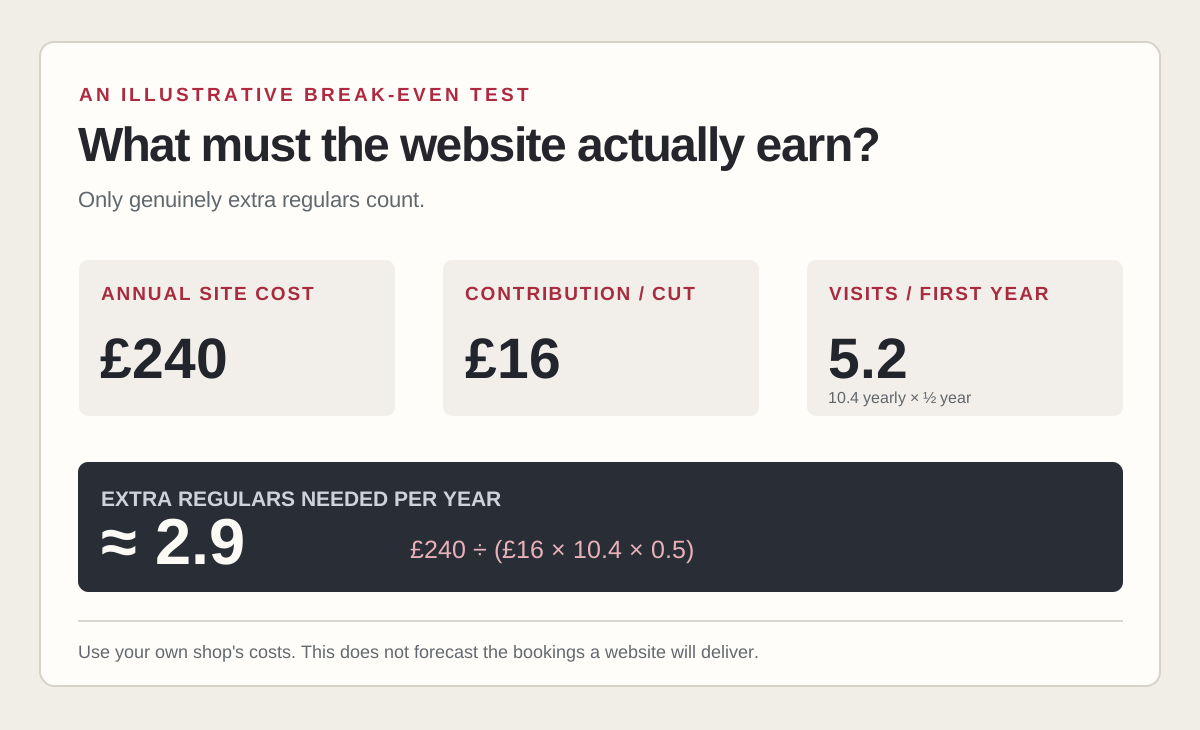
extra regulars needed per year = annual site cost ÷ (contribution per visit × visits per year × share of the year an average new regular stays)
Illustratively: a site costing £240 a year, a cut that leaves £16 of contribution after products, card fees and any commission, a regular who visits every five weeks (about 10.4 visits a year), and new regulars who on average stay half of their first year. That gives £240 ÷ (£16 × 10.4 × 0.5) ≈ 2.9 extra regulars a year. Those are illustrative inputs, not benchmarks, so put your own in. The extra regulars also have to be genuinely extra: clients who wouldn’t have booked without the site.
New clients aren’t the whole story, though. A site can also mean fewer booking questions by phone or direct message, prices and cancellation terms that clients have seen before they arrive, a brand that looks the way you want it to, and one address to put on every card and profile. None of these has a reliable price tag. Count them as reasons, not as numbers in the sum.
The short version
- If Maps and word of mouth fill your diary, you may not need a website. Don’t buy one out of guilt.
- If clients can’t find prices, can’t book out of hours, or don’t know your cancellation terms, a simple page solves a real problem.
- If you’re a limited company with a site, check the footer for the required disclosures.
- Start small. A one-page site or a booking page often does the whole job.
- Judge it by bookings and policies, not by visitor numbers.
References
- The Provision of Services Regulations 2009 (SI 2009/2999), regulation 8 (information to be made available, including price; 8(2)(c) electronic access). legislation.gov.uk/uksi/2009/2999/regulation/8 (accessed 16 Oct 2026).
- The Company, Limited Liability Partnership and Business (Names and Trading Disclosures) Regulations 2015 (SI 2015/17), regulations 24 and 25. legislation.gov.uk/uksi/2015/17 (accessed 16 Oct 2026).
- Google Business Profile Help, Tips to improve your local ranking on Google. support.google.com/business/answer/7091 (accessed 16 Oct 2026).