
Making Tax Digital for Barbers: What Changes When Your Takings Pass £30,000

Updated for HMRC guidance available on 19 October 2026. This is a practical guide for self-employed UK barbers, not individual tax advice. Tax thresholds and dates are based on the legislation and HMRC guidance cited below.
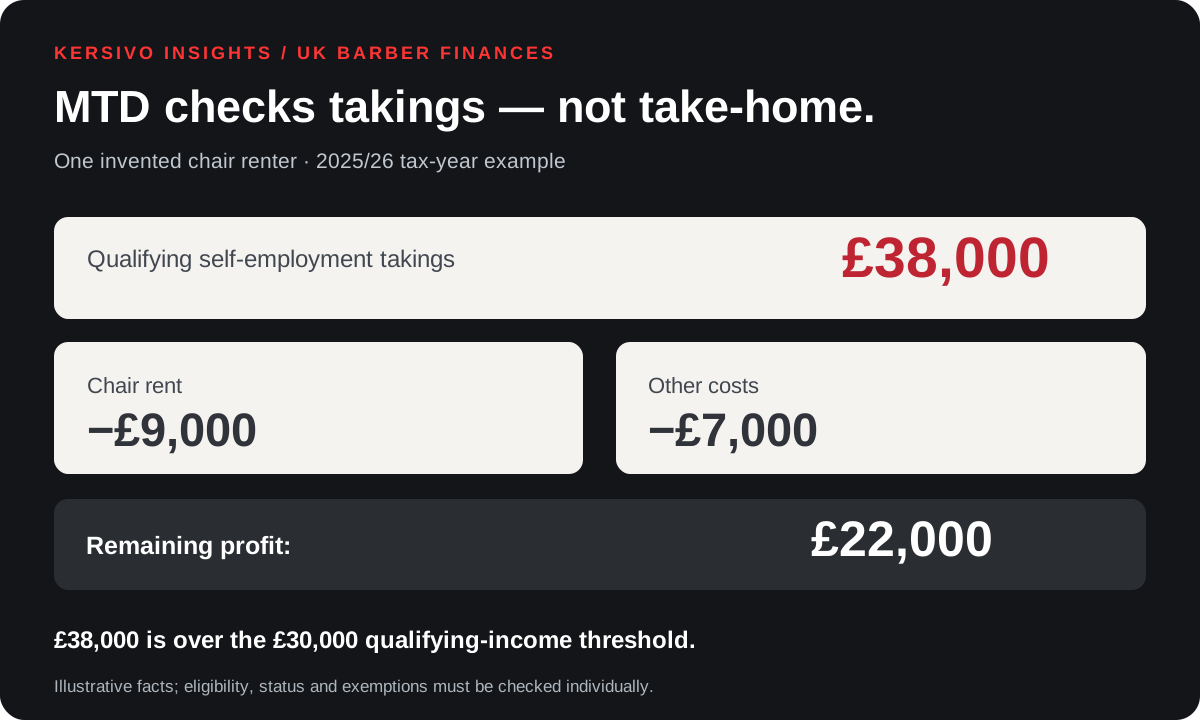
A chair renter may finish the year with £22,000 profit after rent and expenses and still have to join Making Tax Digital for Income Tax from 6 April 2027. Why? Because if that barber reported £38,000 of qualifying takings in 2025/26, HMRC looks at the £38,000, not the £22,000 left afterwards.
For barbers, the hardest part of this change is not understanding that records will become digital. It’s working out whose takings count, which tax year matters, and where your income really comes from when bookings, cash and card payments are split across several systems.
The £30,000 rule: turnover, not take-home pay
Making Tax Digital for Income Tax (MTD) is a change to how certain sole traders and landlords keep digital records and report income and expenses. It does not introduce a new tax on top of Income Tax. Eligible people use compatible software to maintain records, send quarterly updates and submit a tax return.
HMRC calls the threshold measure qualifying income: gross income from self-employment and property, before expenses, generally assessed using the Self Assessment return submitted for an earlier tax year. Separate self-employed businesses and property income can add together.
| Qualifying income shown in | Threshold exceeded | MTD starts |
|---|---|---|
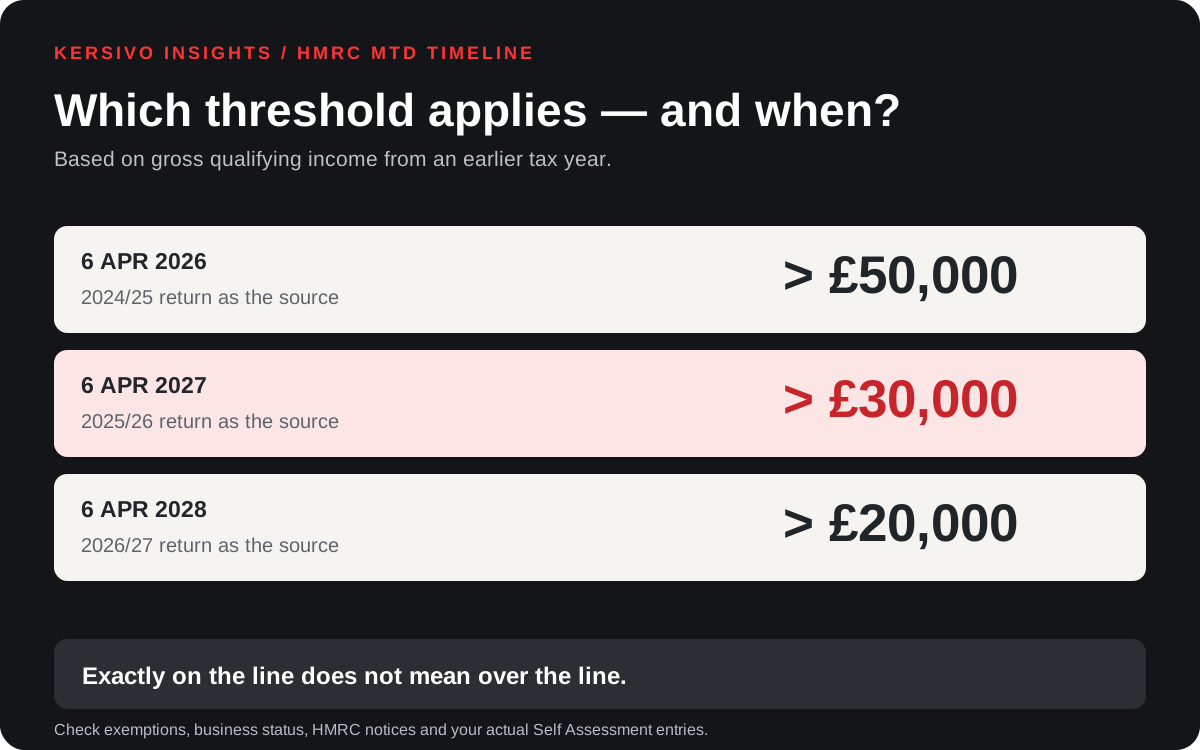
| 2024/25 tax return | More than £50,000 | 6 April 2026 |
| 2025/26 tax return | More than £30,000 | 6 April 2027 |
| 2026/27 tax return | More than £20,000 | 6 April 2028 |
More than is important. Exactly £30,000 is not above the £30,000 threshold. Eligibility, exemptions and any changes to income sources need checking against HMRC’s full guidance.
A barber might take £38,000 through their business over a year, pay £9,000 in chair rent and £7,000 in other allowable costs, and make £22,000 profit. If that £38,000 is qualifying self-employment turnover on their 2025/26 return, the 2027 threshold is met despite the lower profit.
The separate VAT registration threshold is not the same test. Don’t confuse MTD for Income Tax with MTD for VAT or assume one registration automatically covers the other.
Three barbers, three different answers
Here are three illustrative situations. They are not real customers and do not determine an individual’s tax status.
| Barber situation | 2025/26 qualifying income example | From April 2027? |
|---|---|---|
| An employed barber paid £42,000 through PAYE, with no self-employed or property income | £0 from the PAYE wages | Not from wages alone |
| An independent chair renter with £38,000 of gross trading income and £22,000 profit after expenses | £38,000 | Generally yes, absent an exemption |
| A sole-trader shop owner with £27,000 trading income and £7,000 qualifying property income | £34,000 combined | Generally yes, absent an exemption |
An employee’s wages paid through PAYE are excluded from this specific qualifying-income calculation. So are dividend income and an individual’s share of partnership profit, although other reporting obligations may still apply. A self-employed barber who also lets a property needs to consider both qualifying income sources together.
For a genuine chair renter, whose haircut sales count as the renter’s trading income depends on the actual commercial and tax arrangement. A shop owner cannot simply add all renters’ customer payments to the shop’s own turnover, nor assume an app payout is automatically the complete gross amount. If a shop takes client payments then pays the renter, check with your accountant who is supplying the service and how the money is booked before using the figures in a tax return.
Your card payouts may not tell the whole story
A barber’s weekly bank deposits are not always the same as the value of services sold. Payment processors and booking platforms may deduct charges before settling the balance.
Take a simple hypothetical payment: a customer pays £100 for services, a card provider charges the barber £2, and the bank receives £98. Where the barber is the seller and responsible for the fee, the books would ordinarily need to distinguish £100 service income from £2 payment expense, not treat £98 as the sale.
However, platform contracts differ. A marketplace may act as an agent or as a principal, and the actual accounting treatment depends on the agreement. Do not assume this £100/£2 example describes every Booksy, Fresha or other platform transaction.
In practical terms, keep or export records that let you reconcile cash appointments, card takings, direct transfers, booking-platform statements, refunds and fees. Classify chair rent and other expenses separately. Ask your accountant about tips, third-party payments and unusual arrangements rather than applying a single blanket rule.
The important habit is to make sure your records support the income figure on the return, not merely the net amount arriving in your bank account.
What changes once you’re required to join MTD?
MTD for Income Tax introduces three recurring requirements:
- Digital records: use software that meets HMRC’s functional requirements to create and retain the relevant income and expense records.
- Quarterly updates: send summaries of your year-to-date income and expense categories through compatible software. HMRC does not receive every individual receipt or invoice in those updates.
- Year-end tax return: review and finalise your information, add other relevant income and adjustments, and submit your tax return through the MTD-compatible process.
This does not mean four separate full tax returns every year, and it does not mean HMRC calculates or collects your final tax bill after each quarterly update. The updates report income and expenses; your year-end return completes the overall calculation.
HMRC publishes a software finder. Some people may keep spreadsheet-based records using an appropriate compatible bridging product, but a normal spreadsheet by itself is not a substitute for software that can meet the MTD submission requirements. Check the exact product before subscribing, especially if you also have a property income source.
KERSIVO is not being presented as HMRC-recognised MTD for Income Tax software. Your barber booking platform may provide useful sales records, but compliant tax recording and submission are separate responsibilities.
Which quarterly deadlines matter to a barber joining in 2027?
For the standard tax-year periods, the first four quarterly updates for someone joining on 6 April 2027 are due on the following dates:
| Activity covered (standard tax-year periods) | Deadline |
|---|---|
| 6 April – 5 July 2027 | 7 August 2027 |
| 6 April – 5 October 2027 (cumulative) | 7 November 2027 |
| 6 April 2027 – 5 January 2028 (cumulative) | 7 February 2028 |
| 6 April 2027 – 5 April 2028 (cumulative) | 7 May 2028 |
A different calendar-quarter option exists if properly selected; the due dates remain the seventh of August, November, February and May, while the record periods differ. Your software should show which period basis applies.
7 November 2026 is not the first deadline for someone who only enters MTD in April 2027. That November 2026 deadline is for people already subject to MTD during 2026/27. Meanwhile, the normal Self Assessment filing requirements for the preceding tax year continue to apply.
If you are already required to use MTD from April 2026 and have missed updates, take action now. HMRC provided a specific 2026/27 soft landing for quarterly-update submission penalties, but that is not a licence to ignore the record-keeping duty or other tax obligations, and you should not assume that an identical arrangement will apply to the group joining in 2027.
Can a barber ask for an exemption?
HMRC recognises exemptions and exclusions in specific circumstances, including certain people who are digitally excluded. Simply disliking accounting apps, not being familiar with them or finding them expensive does not automatically qualify someone.
If you believe you cannot reasonably use software because of disability, age, remoteness or another relevant recognised reason, consult HMRC’s published exemption guidance and, where necessary, apply using the stated process. Other statutory exemptions and deferrals also exist. Avoid assuming you qualify without checking.
If you’re trading through a limited company or a partnership, don’t apply sole-trader start-date rules mechanically. Company tax rules and the future MTD rollout for partnerships are different questions. Confirm your status with HMRC or an accountant before deciding whether to sign up.
A practical checklist for independent barbers
You can prepare without buying new software today.
- Check your 2025/26 Self Assessment figures. Find the gross turnover before chair rent, supplies, platform fees and other expenses. Include qualifying property or other sole-trade income where applicable.
- Reconcile booking reports to payments. Track cash, card, app-based bookings, refunds and withheld processor charges in a way that explains the full amount.
- Separate each business’s income. If renters run their own businesses, keep their sales records distinct from the shop owner’s trading income.
- Choose genuinely compatible tax software. Check HMRC’s official finder, support for your specific income sources, and any accountant or bridging-software workflow.
- Check HMRC notices and your start date. HMRC may write after reviewing your tax return; you remain responsible for checking eligibility even if a letter does not arrive.
- Clarify your special cases early. Tips, platforms acting as principal, non-standard accounting periods, rental income and exemptions deserve individual advice before deadlines arrive.
For barbershop owners managing several chairs, this is ultimately an exercise in clear business records: know which money belongs to your shop and which belongs to each independent barber.

KERSIVO’s role is to help shops control their brand, bookings and operating information — not to replace a bookkeeper, accountant or HMRC-compatible tax product. Understanding the sales flow makes it easier to produce accurate records, whichever software you choose.
Official sources
Rules checked against GOV.UK and HMRC guidance available 19 October 2026:
- HMRC: Find out if and when you need to use MTD for Income Tax — thresholds, tax-year lookback, start dates and exceptions.
- HMRC: Work out your qualifying income — income before expenses and which sources count.
- HMRC: Create digital records — record-keeping requirements.
- HMRC: Send quarterly updates — cumulative updates, information sent and deadlines.
- HMRC: Choose compatible software — functional software requirements.
- HMRC: Exemptions — exclusions and relevant procedures.
- 2026 Income Tax Digital Obligations Regulations — statutory record-keeping and update framework.
The hypothetical examples do not describe real shops and should not be used as a tax computation. If your commercial arrangement is unusual, your accountant should check the underlying transactions before you rely on a threshold calculation.