
What Does a UK Barbershop Owner Actually Earn? A Model Profit and Loss, Chair by Chair
Illustrative England-based model using 2026/27 tax and employment assumptions, checked 19 October 2026. These are invented businesses, not a survey or a UK average. General financial information, not individual tax or accountancy advice.
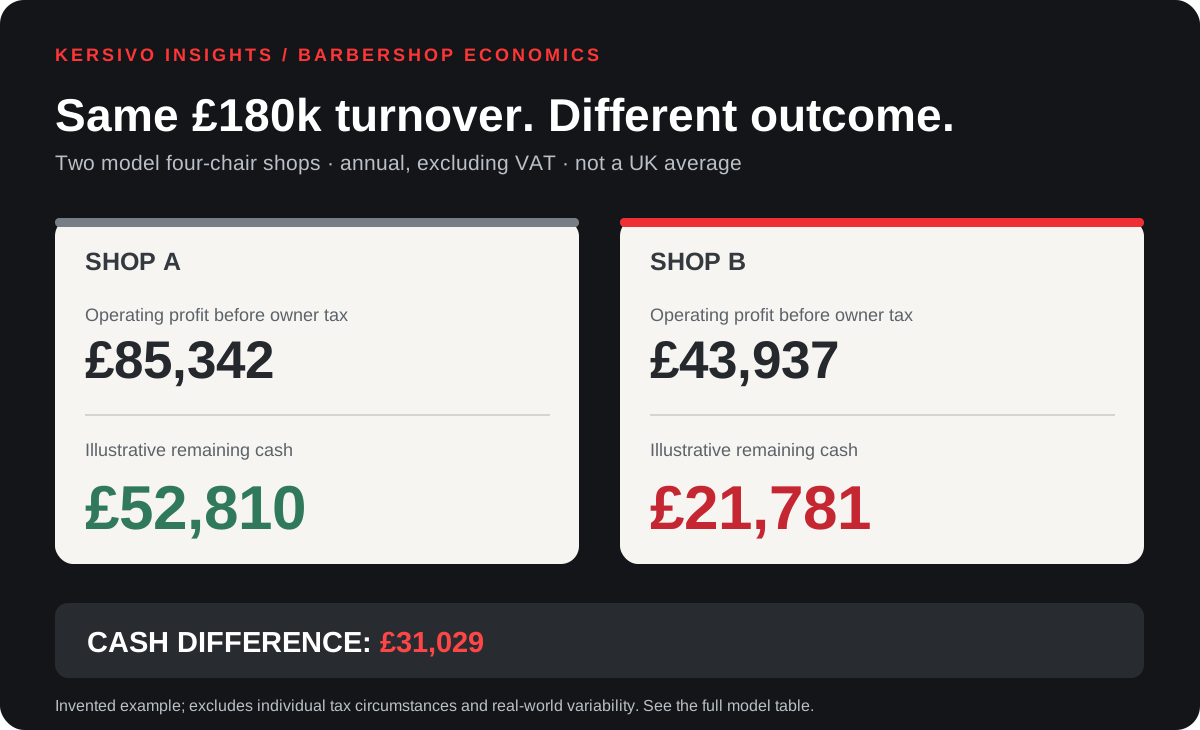
Two four-chair barbershops can bring in exactly the same £180,000 of annual takings, excluding VAT. Yet one might leave its working owner about £52,810 in cash after the modelled taxes, borrowing repayments and equipment spend. The other might leave about £21,781.
That £31,029 difference is not proof that UK barbershop owners usually make either amount. It’s a worked example of why a shop’s turnover, its accounting profit and what its owner can actually take home are three different numbers.
The three cost lines doing most of the damage? Staff pay, premises, and the fees and products attached to each cut.
First, what counts as a barbershop owner’s earnings?
Turnover is what customers pay for services and products, before the shop pays any bills. In this model, the £180,000 figure is net of VAT. Both shops are assumed to be VAT registered; VAT collected and reclaimed sits outside the profit-and-loss comparison. The UK’s compulsory VAT registration threshold is currently £90,000 in taxable turnover, subject to the official rolling-period rules.
Operating profit is the shop’s revenue after its business expenses, but before the sole trader owner’s personal Income Tax and Class 4 National Insurance. It is not a salary. In a sole-trader business, the owner’s withdrawals are generally drawings, not a deductible staff wage.
Owner labour value is an analytical adjustment: what it might cost to hire someone to perform the owner’s own haircutting hours. It helps you see the return from owning the business separately from the value of working behind the chair. It is not an extra invoice or a tax deduction.
Cash available is a fourth number: profit less estimated personal tax and actual financing/capital cash outlays. That still doesn’t necessarily equal money safe to spend; tax payments on account, working capital, VAT timing and other commitments matter.
If a headline promises ‘barbershop owners earn £80k’ without telling you which of those numbers it means, it is not giving you a useful benchmark.
The four-chair model: same revenue, two very different businesses
Both hypothetical shops have one owner working a chair and three employed barbers. Each chair generates £45,000 of yearly sales excluding VAT: £45,000 from the owner’s chair plus £135,000 from the other three.
The employed barbers are paid a percentage of their own chair sales: 40% in Shop A (£18,000 each) and 50% in Shop B (£22,500 each). For wage-compliance plausibility, the model assumes each is paid for 26 hours per week over 52 paid weeks, with statutory leave contained in the annual pay assumption. That gives annualised averages of about £13.31 and £16.64 per paid hour respectively, above the 2026 National Living Wage of £12.71 for someone aged 21 or over. Actual minimum-wage compliance must hold for each pay reference period, not just on an annual average. Real holiday entitlements, overtime, paid absences, other duties and contract terms need a payroll check.
For the three employees, an illustrative employer pension contribution uses 3% of annual qualifying earnings between £6,240 and £50,270. Employer National Insurance before any allowance is £5,850 for Shop A and £7,875 for Shop B, on these simplified annual salaries. Both are assumed eligible for Employment Allowance; the 2026/27 allowance is up to £10,500, so the model nets those employer NI charges to zero. Not every employer qualifies, and other wages or payroll obligations could change the result.
Here is the yearly shop profit-and-loss, rounded to whole pounds.
| Annual item, excluding VAT | Shop A | Shop B |
|---|---|---|
| Turnover, four chairs | £180,000 | £180,000 |
| Employed barber pay | −£54,000 | −£67,500 |
| Employer NI after assumed Employment Allowance | £0 | £0 |
| Employer pension contribution | −£1,058 | −£1,463 |
| Shop rent | −£18,000 | −£30,000 |
| Business rates after assumed reliefs | £0 | −£6,000 |
| Card processing and booking costs | −£3,600 | −£6,300 |
| Products and consumables | −£7,200 | −£10,800 |
| Utilities | −£4,800 | −£6,000 |
| Other operating overhead | −£6,000 | −£8,000 |
| Operating profit before owner’s personal tax | £85,342 | £43,937 |
This is an invented annual illustration, not observed UK barbershop margins. Fees at 2% versus 3.5%, products at 4% versus 6%, rent and rates are hypothetical inputs. Payroll, business rates relief and costs will vary. Rounded figures may differ by £1 from calculations using unrounded amounts.
A shop making £180,000 in annual sales does not have £180,000 to distribute. Even before tax, the example businesses finish £41,405 apart.
Three lines explain most of the £41,405 profit gap
1. Staff pay: £13,500. Three barbers selling £45,000 each earn £54,000 altogether at 40% commission or £67,500 at 50%. Neither commission percentage is automatically ‘right’. Higher pay may help retention, recruit stronger barbers or reward more demanding services. It must also satisfy minimum-wage rules in practice.
2. Premises: £18,000. Shop A spends £18,000 on rent and is assumed to qualify for enough relief to have no rates bill. Shop B pays £30,000 rent plus £6,000 rates. An expensive location can be worthwhile if it produces better prices and steadier demand; here turnover is deliberately held constant to isolate cost.
3. Booking/card fees plus consumables: £6,300. Shop A spends £10,800 on those lines combined; Shop B spends £17,100. Some card processing is unavoidable when taking cards, and a more expensive booking setup may provide useful services. The point is to measure the complete cost rather than assume every percentage is buying value.
Together those differences account for £37,800 of the £41,405 profit gap. Pension, utilities and other overhead explain the remaining £3,605.
A slightly fuller diary will not automatically fix a structurally expensive shop. Conversely, cutting the wrong expense — such as pay needed to keep trusted barbers — could damage repeat visits. A profit-and-loss table starts a better decision; it does not make the decision for you.
Profit is not the same as the owner’s cash
Now assume each owner operates as a sole trader in England with no other taxable income, a standard personal allowance and the published 2026/27 Income Tax and Class 4 National Insurance bands. The figures below use the unrounded profit calculations. Scotland has different non-savings Income Tax rates; a limited company, a partnership or a person with other income would require different treatment.
| Illustrative owner money flow | Shop A | Shop B |
|---|---|---|
| Unrounded shop profit | £85,341.60 | £43,936.60 |
| Estimated Income Tax and Class 4 NI | −£24,532.07 | −£8,155.32 |
| Loan principal cash repayments | −£6,000 | −£12,000 |
| Equipment/replacement cash spend | −£2,000 | −£2,000 |
| Illustrative cash remaining | £52,809.53 | £21,781.28 |
| Rounded cash remaining | £52,810 | £21,781 |
Capital repayments and equipment cash purchases are shown after profit and tax for cash-flow comparison. They are not automatically deductible business expenses in the same way as day-to-day costs. Actual interest, capital allowances, depreciation, tax adjustments and cash timing would affect a real return.
This is why the owner who boasts of an £85,000 accounting profit may not have £85,000 sitting in their current account.
There is another distinction. Both owners are personally supplying £45,000 of the shop’s turnover by cutting hair. If you use each shop’s own hypothetical staff commission rate to value that work, the implied owner-chair labour values are £18,000 and £22,500. Removing that notional amount from operating profit leaves £67,342 in Shop A and £21,437 in Shop B as an analytical comparison of the shop return beyond the owner’s own haircutting contribution. Do not deduct those numbers again from tax or cash: they are an opportunity-cost lens, not an actual payroll entry.
Two, four or six chairs: what does an extra chair add?
Scaling is tempting because a chair can earn money when its barber is working. But another chair is not automatically another owner’s salary.
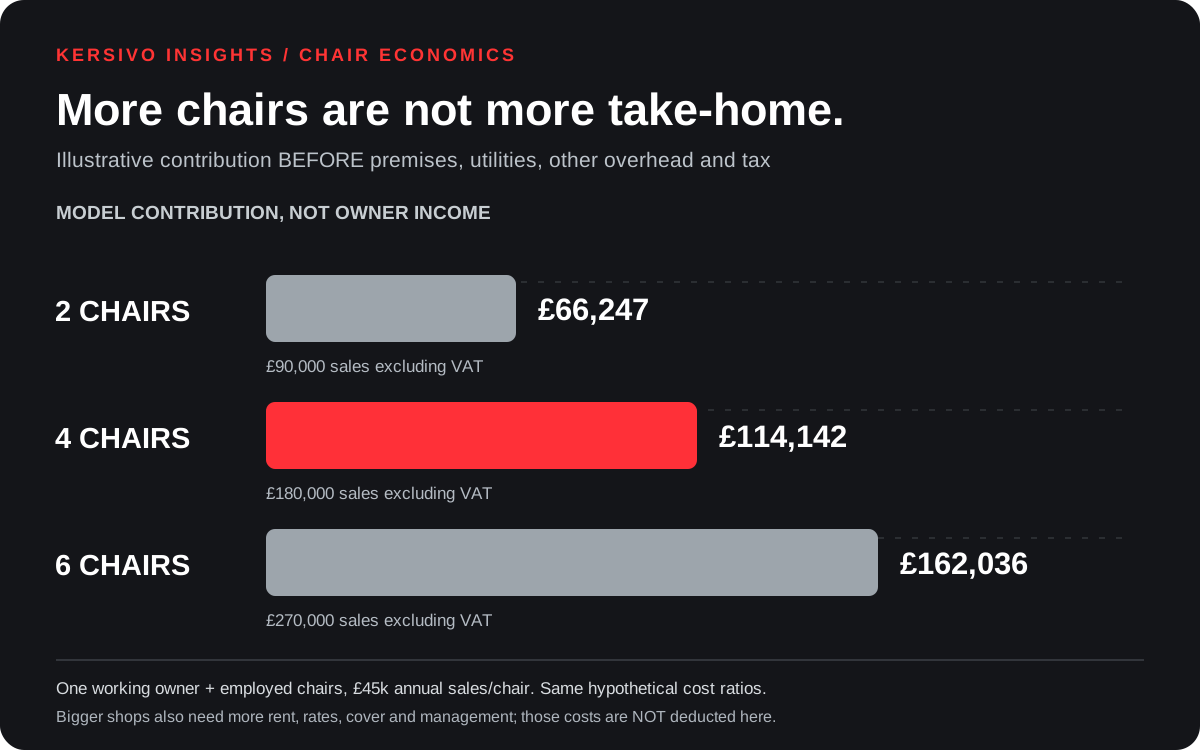
Take Shop A’s same hypothetical mix. The working owner generates £45,000 a year on their chair. Each employed chair generates £45,000, pays £18,000 of commission and around £353 employer pension, plus £900 combined card/booking fees and £1,800 consumables. With the stated Employment Allowance eligibility and NI assumptions, that leaves about £23,947 of incremental contribution per employed chair before rent and other fixed overhead.
| Shop size | Total model turnover | Contribution before rent, rates, utilities and other fixed overhead |
|---|---|---|
| 2 chairs: owner + 1 employee | £90,000 | £66,247 |
| 4 chairs: owner + 3 employees | £180,000 | £114,142 |
| 6 chairs: owner + 5 employees | £270,000 | £162,036 |
Pure sensitivity illustration, not owner take-home or UK industry averages. Revenue scales with the number of productive chairs and does not account for demand limits, larger premises, relief eligibility, different VAT circumstances or additional management. The hypothetical Employment Allowance covers the estimated employer NI in all three variants, if eligible.
The difference between the rows looks attractive before you pay for extra floor space, equipment, electricity, supervision, recruitment, cover for sickness and holiday, and quieter weeks. The six-chair number isn’t evidence a six-chair owner ‘makes £162k’. It is an amount from which substantial costs still have to come.
Employed barbers, commission or chair rent: do not mix the accounts
A percentage-paid employee is still an employee. The business has to handle wages, holiday rights, qualifying pensions and employer obligations. The fact that the payment varies with service takings does not turn the barber into a self-employed renter.
With genuine chair rental, the shop might receive a fixed rental amount while the renter takes and reports their own customer sales. Those sales are not automatically the shop owner’s turnover, and the shop cannot simply treat renter takings as if they belonged to its own payroll business. Employment status depends on the real arrangement, not the contract heading.
A shop mixing both arrangements needs a separate revenue and cost view for employed chair sales, owner-performed sales and rent received. If you combine everything into one ‘£180k shop turnover’ figure, you may be comparing completely different businesses.

The three checks worth making in your own shop
For the next four weeks, record net sales per working chair-hour (excluding VAT where appropriate), true staff cost per paid hour (including pension, holiday and employer charges) and all-in premises and booking costs. Track cancellations or unsold slots too. A headline diary occupancy percentage tells you less than actual income per available hour.
Then calculate a simple owner view:
- What is left after running costs? Separate owner-performed work from other chair sales, staff expenses and rent received.
- What would replacing your own chair work cost? Treat that as an analytical opportunity cost, never disguise drawings as payroll.
- How much cash can you safely take out? Reserve for tax, VAT, equipment, borrowing, bills and the inevitable quiet week.
If the bottleneck is underused chair capacity, the booking journey and no-shows may be worth fixing. If it is high rent or a wage structure, buying another booking app will not solve the main problem.
KERSIVO’s viewpoint is simple: own the client relationship and understand what each booking contributes. But software is one cost line, not a substitute for controlling the whole business. Read our guide to why a full barbershop diary can still deliver low profit, or use the barber software cost calculator to examine one component of your overhead.
Sources and model notes
The shop figures in this article come from a constructed four-chair example, not reported accounts, a customer case study or an established UK margin survey. They illustrate what changes when business inputs change. The National Hair & Beauty Federation’s analysis of wage-cost pressures provides sector context, not a profit benchmark for these invented shops.
2026/27 rules and definitions used in the model:
- HMRC: National Insurance rates and thresholds for employers, 2026–27 — 15% employer rate, £5,000 secondary threshold and £10,500 Employment Allowance for eligible employers.
- GOV.UK: National Minimum Wage rates — £12.71/hour for workers aged 21 and over from April 2026; check the relevant pay reference period.
- The Pensions Regulator: qualifying earnings thresholds — £6,240–£50,270 in 2026/27.
- HMRC: Income Tax rates and allowances and Class 4 National Insurance — simplified England sole-trader calculation.
- GOV.UK: VAT registration threshold — compulsory registration generally starts above £90,000 taxable turnover in a rolling 12 months, or when expected to exceed that threshold in the next 30 days.
- HMRC: private and personal expenditure / proprietor drawings — a sole trader’s drawings are not an employee wage expense.
Every real shop needs its own numbers. If you intend to act on a staffing, tax or ownership decision, review the current official rules and discuss the particulars with a qualified accountant or employment adviser.