
Six Months, Not Two Years: How the 2027 Unfair Dismissal Change Affects Barbershops That Employ Staff
General information, not legal advice. Applies to employees in England, Wales and Scotland. Northern Ireland has its own rules. Checked and revised 16 October 2026. This is general information, not a substitute for advice on a specific dismissal.
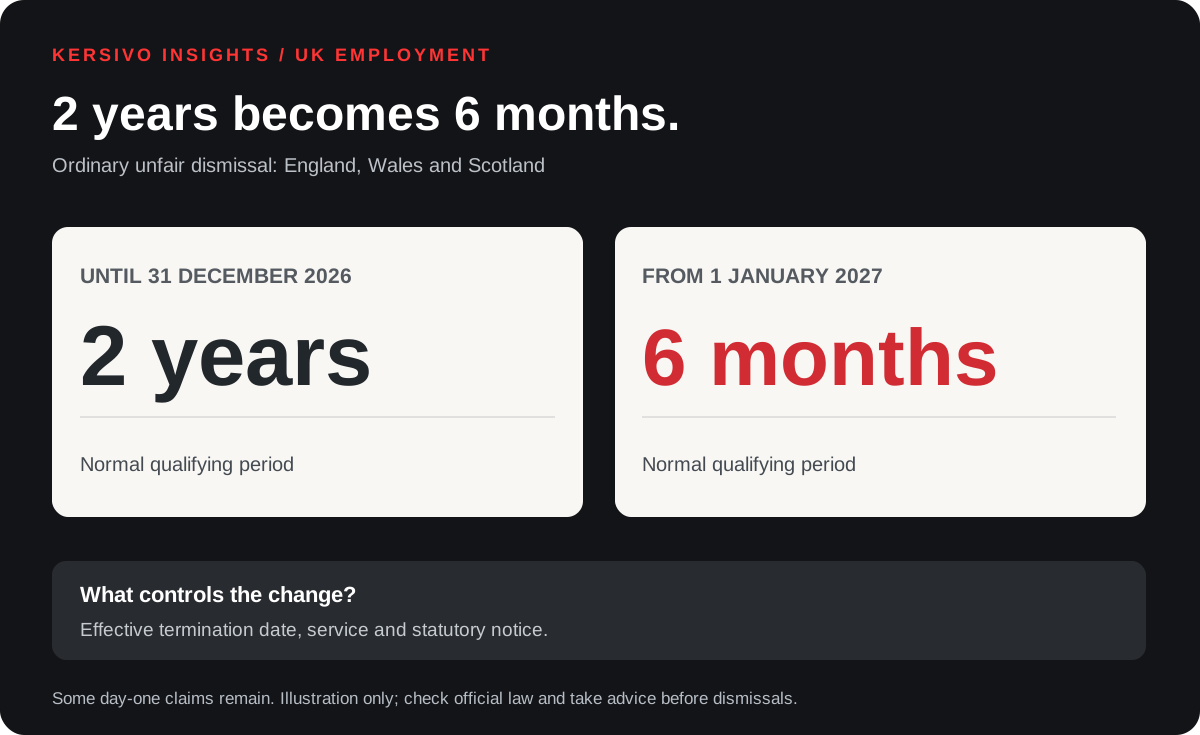
For years, many small employers have treated the first two years of employment as a grace period. If a new barber wasn’t working out, the shop could often let them go without the risk of an ordinary unfair dismissal claim, though discrimination and other day-one claims were always possible. From 1 January 2027, that period shrinks to six months.
The change sounds like a matter for HR departments. For a barbershop with two or three employed barbers, it’s more practical than that. It moves the moment when the way you hire, train and review people starts to matter legally, and for some people hired this year that moment arrives sooner than it looks.
What the law now says
The Employment Rights Act 2025 amends section 108 of the Employment Rights Act 1996, replacing “two years” with “six months” as the qualifying period for the right not to be unfairly dismissed. The commencement regulations bring this into force on 1 January 2027. The same section removes the cap on the compensatory award for unfair dismissal. That doesn’t mean unlimited automatic payouts: the government’s guidance says awards will still be calculated on the claimant’s actual and projected losses, as evidenced, and tribunals will still look at things like whether the employee took reasonable steps to find other work and what is just and equitable. It also notes that most awards are well below the current cap.
The government’s employer guidance also confirms that the qualifying period for asking for written reasons for dismissal falls to six months. Day-one protections, such as protection from discrimination and from automatically unfair dismissal (for example, for reasons related to pregnancy or whistleblowing), don’t change. Those claims don’t need any qualifying period, before or after January. The qualifying period for protection against unfair dismissal on grounds relating to spent convictions is removed altogether. That’s worth knowing if you hire people who have previously been in trouble with the law and who have disclosed old convictions.
Timing is set by the “effective date of termination”, usually the date employment actually ends. Under the transitional rules, the new six-month period applies where that date falls on or after 1 January 2027, even if the dismissal itself happened earlier. Where it falls before 1 January 2027, the two-year rule still applies.
Why the date needs care
Whether a particular employee is covered depends on their own start date and on when their employment ends, not on a rule of thumb.
Count to the effective date of termination. The question is whether the employee has six months’ continuous employment by the effective date of termination. Someone who started on 1 July 2026 reaches six months at the turn of the year; someone who started in September doesn’t until March 2027. Each start date gives a different answer.
Statutory notice counts. The government’s guidance says statutory minimum notice periods are treated as service when working out whether a dismissal falls within the qualifying period, whether or not the notice was actually given (section 97(2) of the Employment Rights Act 1996). For an employee with between one month’s and two years’ service, statutory notice is one week. So dismissing someone a few days before they reach six months may not keep them outside the protection.
The transitional rule. The new period applies where the effective date of termination falls on or after 1 January 2027, even if the dismissal was decided or notified earlier. If notice runs past 1 January, the new rule can apply.
None of this means that ending someone’s employment before six months is safe. Discrimination and automatically unfair dismissal claims don’t depend on length of service at all. An owner planning a decision around any date should take advice rather than rely on the calendar.
What this changes in a small shop
The legal test for fairness isn’t new. A dismissal needs a fair reason, such as conduct, capability or redundancy, and a fair process. What changes is how soon an employee can bring a claim if those are missing.

For a barbershop, that has three practical effects.
Probation and the qualifying period are different things. A probation period is whatever your contract says it is. The six-month qualifying period is set by law, and it applies whether or not you have a probation period, and whatever its length. The law doesn’t require a six-month probation. What it changes is that after six months’ service an employee can claim unfair dismissal, so an informal trial that drifts past that point gives you no extra protection. The government’s guidance suggests employers consider how a contractual probation period will work alongside the new rule.
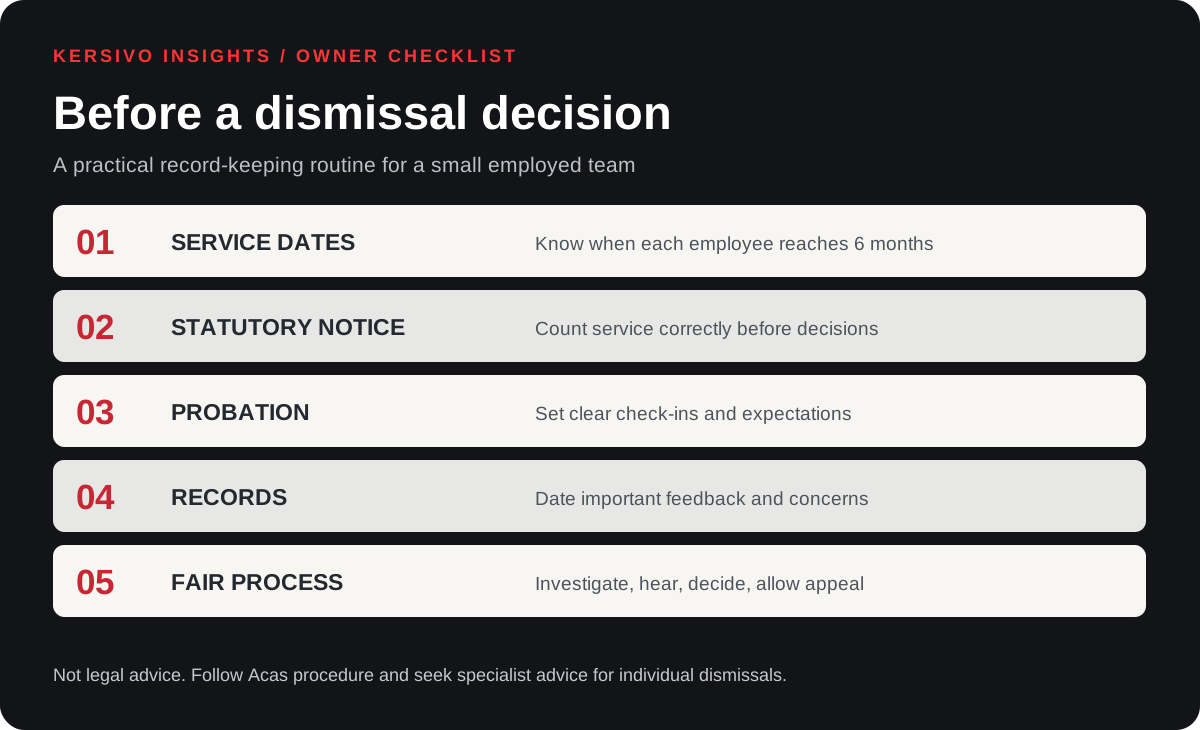
Records matter earlier. Notes of conversations about lateness, standards or client complaints used to matter mostly for long-serving staff. Now they matter within months. A short, dated note after each conversation is more useful than a long file assembled after the event.
Process isn’t optional. The Acas Code of Practice on disciplinary and grievance procedures sets the basic steps: investigate, tell the employee the concern, hold a meeting, allow them to be accompanied, and give a right of appeal. Tribunals can increase awards by up to 25% where an employer unreasonably fails to follow the Code. With no compensation cap from January, a sloppy dismissal of someone with long service or large losses can cost more than it used to.
Who it doesn’t cover
The right to claim unfair dismissal belongs to employees. GOV.UK lists self-employed people and independent contractors among those who can’t claim. So a genuinely self-employed chair renter isn’t covered by this change.
The word “genuinely” matters. Employment status depends on how the arrangement works in practice, not on what the contract calls it. A “renter” whose hours, prices and clients are controlled by the shop may in fact be a worker or an employee. Shops with renters should see this change as another reason to make sure the arrangement matches the label.
Owner-operators with no staff aren’t affected at all. Shops with employed teams are affected most, and a mixed shop with some employed and some renting barbers will be affected only for the employees.
An honest objection
Some owners will say this makes hiring riskier and that the sensible response is to hire less. That’s a real concern for very small businesses, where one bad hire can upset the whole shop.
But most of what protects an employer under the new rules is also good management. Clear expectations, regular feedback and a fair process before letting someone go are what a well-run shop does anyway. The change mostly penalises shops that make decisions on instinct and explain them afterwards. For those that already manage carefully, the main difference is paperwork they should probably have been keeping.
Before January
If you employ barbers, list each employee’s start date and note when they pass six months, allowing for a week of statutory notice. Check that your contracts and probation terms are clear about how long probation lasts and what happens at the end of it. Agree a simple way of recording conversations about performance. And if you’re considering ending someone’s employment in the next few months, take advice from an employment-law specialist now rather than after the notice is given.
None of this requires a lawyer for every decision. It requires treating the first six months of employment as the period in which you decide, properly, whether someone is right for the shop, because after that the law will expect you to have a good reason and a fair process.
References (checked 16 October 2026; rechecked in v2)
- Employment Rights Act 2025, s. 25 — https://www.legislation.gov.uk/ukpga/2025/36/part/1/crossheading/dismissal
- The Employment Rights Act 2025 (Commencement No. 4 and Transitional and Saving Provisions) Regulations 2026 (SI 2026/559), regs 3–4 — https://www.legislation.gov.uk/uksi/2026/559/made
- Business.gov.uk, Unfair dismissal rights (employment changes for employers) — https://www.business.gov.uk/campaign/employment-changes/employers/unfair-dismissal-rights/
- GOV.UK, Dismissing staff: eligibility to claim unfair dismissal — https://www.gov.uk/dismiss-staff/eligibility-to-claim-unfair-dismissal
- Acas Code of Practice on disciplinary and grievance procedures — https://www.acas.org.uk/acas-code-of-practice-on-disciplinary-and-grievance-procedures
- Trade Union and Labour Relations (Consolidation) Act 1992, s. 207A (adjustment of awards up to 25%) — https://www.legislation.gov.uk/ukpga/1992/52/section/207A
- Employment Rights Act 1996, s. 97(2) (statutory notice and effective date of termination) — https://www.legislation.gov.uk/ukpga/1996/18/section/97