
Barbershop Loyalty Schemes: Who Are You Rewarding, and What Does It Buy?

The stamp card is one of the most familiar loyalty schemes on British high streets: ten stamps, one free cut. It’s cheap to print, clients understand it at a glance, and it feels generous. Digital versions do the same thing with an app and a QR code.
What’s rarely asked is the question every discount should face: what does the shop get for it? A loyalty scheme gives away part of your revenue to your most reliable clients, the people who were going to come back anyway. That can still be a good deal. But it’s a deal, and like any deal it can be priced.
This article doesn’t cover how to win a second visit; that’s a different problem. It’s about the regulars you already have, and whether rewarding them changes anything.
Question 1: what does the free cut actually cost?
Take a simple card: buy nine cuts, get the tenth free. At a £22 price, the shop gives away £22 every ten visits, a 10% discount on that client’s visits. Whether that is a large or small cost depends on one thing: would the client have paid for that tenth visit anyway?
- If yes (a regular who comes every five weeks regardless), the free cut replaces a paid one. The shop gives up £22 of revenue. In contribution, it loses the £19 that paid visit would have left (£22 − £3) and still spends about £3 on products for the free one, so the cost is also about £22. If the barber is on a fixed wage, their time doesn’t change the cost either way.
- If no, meaning the free cut is an extra visit that wouldn’t otherwise have happened, in a slot that would have been empty, no paid revenue is lost. The cost is close to just the variable cost of the cut, about £3 in this illustration (a little less, as there’s no card fee on a free cut).
If the shop is full when the free cut is redeemed, it can also push out a paying client, which costs a paid visit’s contribution on top.
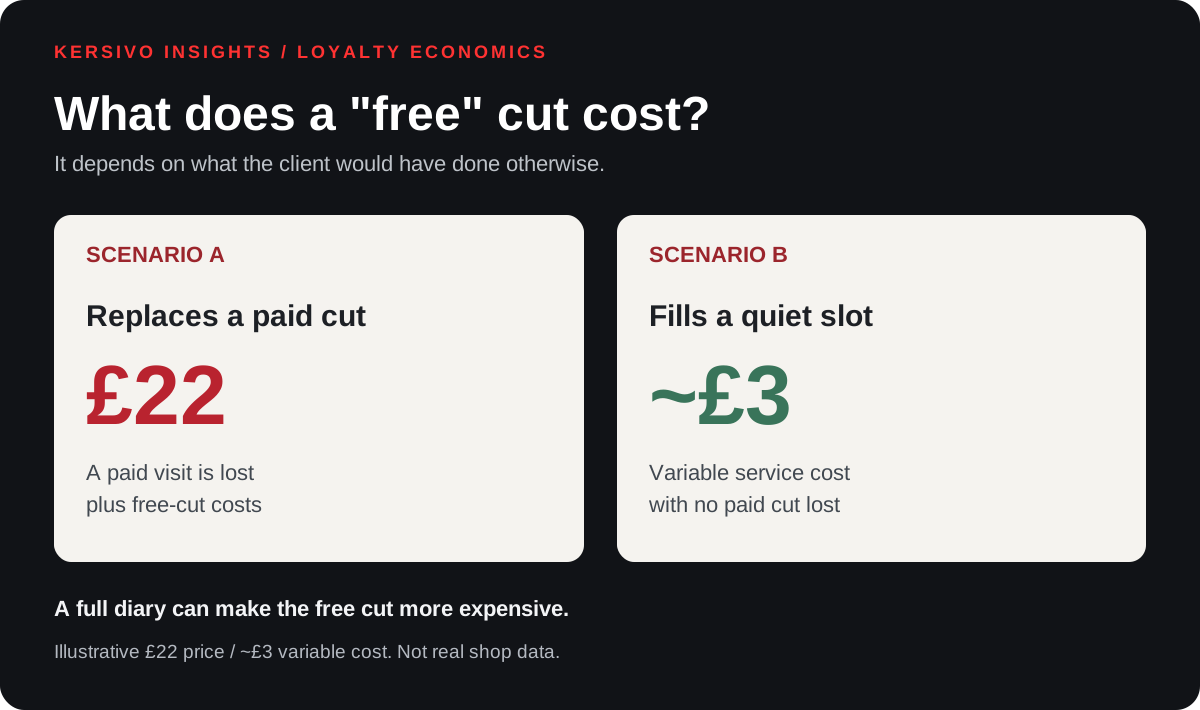
The illustration assumes a £22 price and roughly £3 of products and card fees per cut. Your figures will differ, so rerun the sums with your own.
Question 2: what would make it pay?
A loyalty scheme only pays for itself if it changes behaviour: clients come more often, or stay longer before drifting away.
Using the same numbers, compare ten visits with and without the card:
- Without the scheme: ten paid visits × £19 = £190 of contribution.
- With the scheme: nine paid visits × £22 − ten visits × £3 of variable cost = £168, or £16.80 per visit.
Every extra visit the card brings also earns a stamp, so it’s worth £16.80 on average, not £19. To get back to £190, the client has to make 190 ÷ 16.8 ≈ 11.31 visits for every ten they made before: about 13.1% more visits in total, paid and free together. (A quicker estimate, £22 ÷ £19 ≈ 1.16 extra paid visits, gives 11.6%. It misses that extra visits earn stamps too.) For a regular who came every five weeks, about 10.4 visits a year, that means about 11.8 visits a year, or coming roughly every 4.4 weeks instead (5 ÷ 1.131).
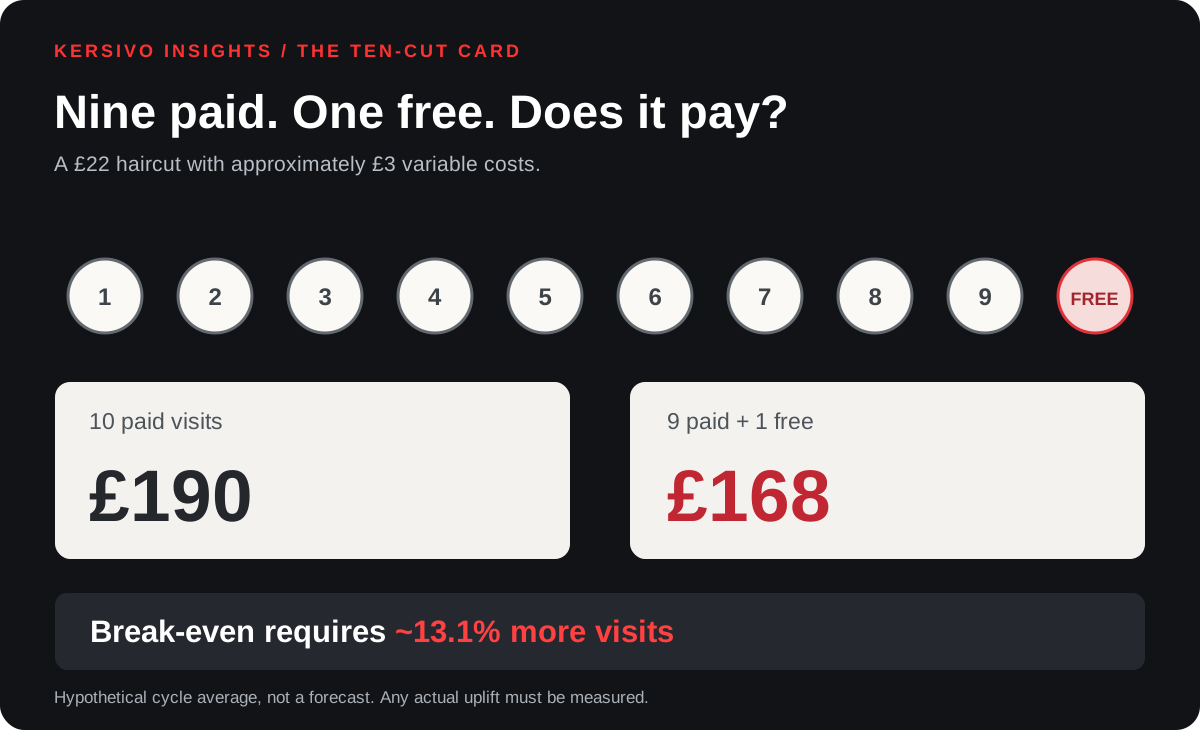
These are averages. In reality the free cut arrives as a whole visit every tenth time, so in any one year a client’s figures will be lumpier than this.
That’s a meaningful change to ask for. Some schemes may achieve it, especially if the reward is close enough to feel within reach, or if the card makes clients rebook sooner. Others won’t. If your regulars already come like clockwork, the card mostly thanks them for doing what they would have done anyway.
There’s a second way a scheme can pay, and it’s harder to measure: retention. If a stamp card makes a client less likely to try the new shop down the road, the value is in the visits you don’t lose. You can’t see a defection that didn’t happen. Comparing card-holders with non-holders is tempting, but it’s biased: the clients who sign up are often the ones who were already most loyal, so they’d lapse less anyway. Fairer checks are comparing the same regulars before and after the scheme starts, ideally over the same months of the year, or, if you’re willing, offering the card to only some clients for a while and comparing the two groups. Even then, other changes in the shop can move the numbers, so treat the result as a guide, not proof.
| What the scheme changes | Value to the shop | How to check |
|---|---|---|
| Nothing (regulars came anyway) | Negative: about 10% of their revenue given away | Visit frequency before vs after |
| Total visits rise by more than about 13.1% | Positive (on these numbers) | Average weeks between visits |
| Fewer regulars lapse | Positive, but hard to see | Lapse rate, card-holders vs others |
| Free cuts fill quiet slots | Small cost (variable cost only) | When rewards are redeemed |
The last row suggests a possible improvement: make the reward redeemable on quieter days. A free cut on a Tuesday morning that would otherwise have been empty costs a few pounds. A free cut on a Saturday afternoon can take the place of a paying client.
Question 3: what are the rules?
Loyalty schemes are lightly regulated, but three points matter.
“Free” has to be genuinely free. The CAP Code, which governs non-broadcast advertising in the UK, says a product must not be described as “free” if the consumer has to pay anything other than unavoidable costs. That includes cases where the price of what they must buy “has been increased”, unless the increase is for reasons unrelated to the promotion (rule 3.23). The advert must make clear the commitment needed to get the offer (rule 3.24). Rule 3.21 says the same about any price that depends on buying something else. In practice: don’t raise the price of a cut to pay for the free tenth, and say clearly “after nine paid cuts”. A routine price rise for unrelated reasons is a different matter, but be able to show it.
Data and messages. A digital scheme collects names, phone numbers and visit histories, which is personal data under UK GDPR. You need a lawful basis for using it, a privacy notice that tells members what you collect and why, and you should keep only what the scheme needs, for no longer than it needs. If you use an app provider, it will usually be processing the data for you, so check its terms. If the app sends promotional messages, the electronic marketing rules (PECR) apply. Without consent, the ICO’s “soft opt-in” allows messages to existing customers only if you got their details during a sale or negotiation, you’re marketing your own similar services, and you offered a simple way to opt out when you collected the details and in every message. The ICO says this guidance is under review after the Data (Use and Access) Act. Check the current version before you set up automated reminders.
Clear terms. Say what counts as a stamp (one per paid cut? per visit?), whether stamps expire, and whether the card works with every barber. Unclear terms are where small disputes start.
The counterargument: loyalty is a feeling, not a spreadsheet
Some owners will find this approach too calculating. A stamp card, they’ll say, isn’t really an economic tool. It’s a gesture. Regulars like being recognised, and a free cut once or twice a year buys goodwill that shows up in referrals, tolerance of the occasional late running, and a warm atmosphere in the shop.
There’s truth in that, and the numbers above can’t capture all of it. But it’s worth being honest about what the gesture costs: on these figures, about 10% of a regular’s revenue, every year, for as long as the scheme runs. If a gesture is what you want, there are cheaper ones. Remembering a client’s name and usual cut. A complimentary beard tidy on a birthday. An occasional unannounced “this one’s on us” for a long-standing regular. These cost far less than a systematic discount, they can’t be expected or gamed, and they feel more personal than a stamp. The numbers don’t rule out loyalty rewards. They suggest giving them deliberately rather than automatically.
If you run one, run it like an experiment
- Record the baseline: average weeks between visits for your regulars, before the scheme.
- Pick the design: reward size, threshold, and whether it’s redeemable at any time or only off-peak.
- Write clear terms and keep “free” claims honest.
- Handle data properly: collect contact details with a clear opt-out and respect it in every message.
- Review after six months: compare the same regulars before and after. Has frequency moved by more than the break-even? Have fewer lapsed? If neither, the scheme is probably working as a discount, not a loyalty tool, and you can redesign or stop it.
A loyalty scheme is one of the few marketing costs that falls entirely on your best clients. That’s a good reason to be sure it changes what they do, not just how much they pay.
References
- Committee of Advertising Practice, UK Code of Non-broadcast Advertising and Direct & Promotional Marketing (CAP Code), section 3, rules 3.21–3.24 (conditional prices; “free”). asa.org.uk (accessed 16 Oct 2026).
- Information Commissioner’s Office, Electronic mail marketing (soft opt-in; guidance under review following the Data (Use and Access) Act). ico.org.uk (accessed 16 Oct 2026).